A hot water tank temperature sensor must match the tank’s measurement point, process connection, readout, and operating conditions. First determine whether the requirement is a control probe, an independent monitoring point, or a replacement sensor; the tank controller and sensor may have different electrical and safety requirements. Follow the tank manufacturer’s installation and safety procedures.
Choose the measurement location
Identify the tank port, thermowell, immersion pocket, or other approved mounting point and the depth at which temperature must be measured. Consider stratification, heater location, circulation, flow, and the control objective. A single probe location may not represent the temperature throughout the tank.
Match the sensor to the controller
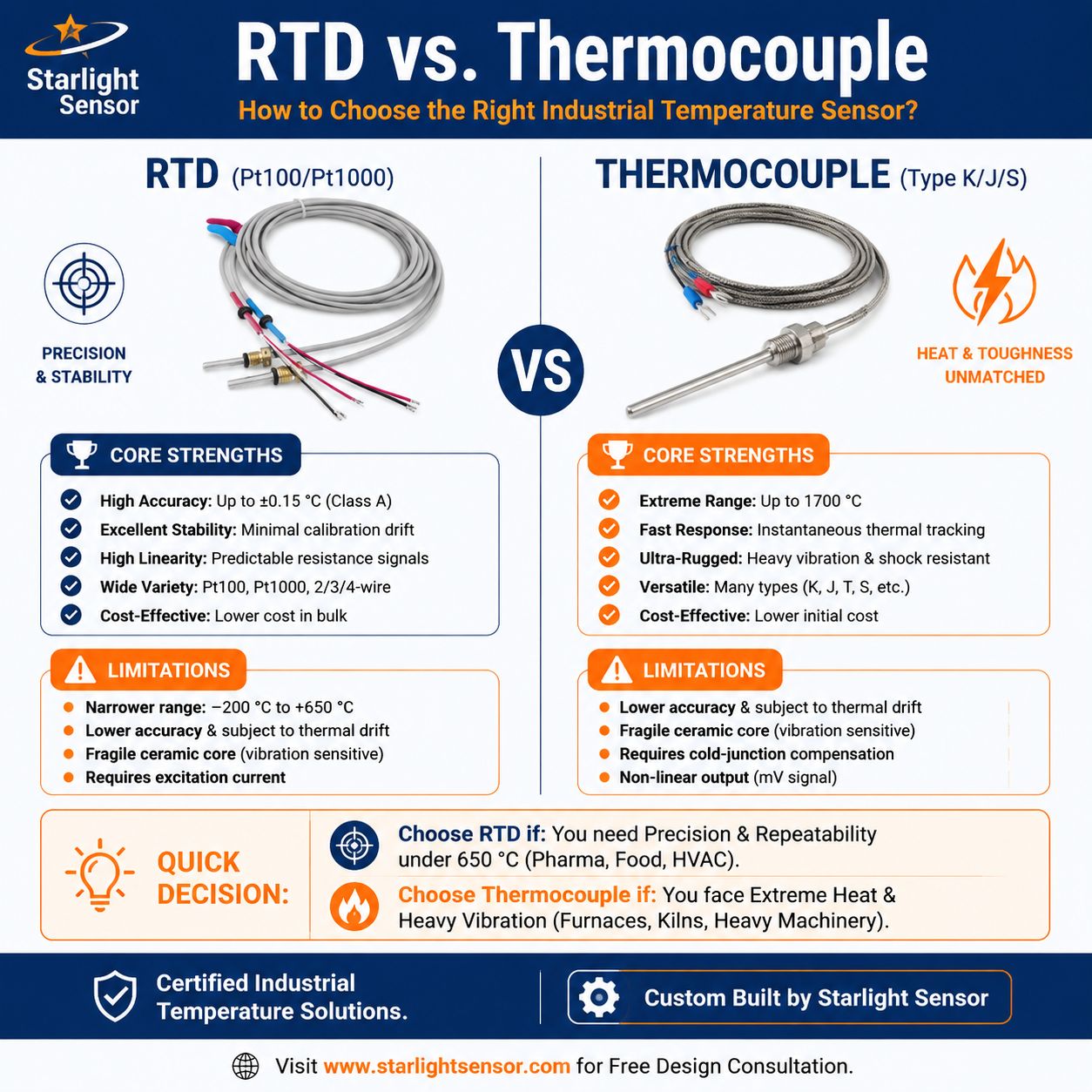
Specify the sensing technology and exact curve/type required by the controller. NTC thermistors need a defined resistance curve and conversion; RTDs require the specified Pt100/Pt1000 configuration and wiring; thermocouples require a matching input and cold-junction compensation. Confirm connector, pinout, cable, input limits, and alarm/control setpoint handling with the equipment documentation before replacing a probe.
Specify the wetted probe assembly
Document sheath material and dimensions, insertion length, sensing point, fitting or thermowell interface, seals, cable, connector, and lead routing. Confirm materials and seals for the water chemistry, pressure, temperature, cleaning treatment, and service life. Pressure containment, vessel certification, electrical protection, and installation must be reviewed by the responsible tank/system designer; do not infer those ratings from a sensor element.
Validate the completed measurement chain
Check probe fit and seal using the approved tank procedure. Compare the sensor and controller at representative operating conditions, verify control response and alarms, and confirm expected behavior during an open circuit, short, or disconnected probe. Document calibration, inspection, and replacement criteria for service conditions.
Hot water tank sensor RFQ checklist
- Tank drawing, measurement purpose, port/thermowell, immersion depth, and location.
- Sensor type/curve, controller model, wiring, connector, input limits, and setpoint use.
- Wetted materials, sheath dimensions, fitting, sealing, cable, and routing.
- Water chemistry, pressure/temperature envelope, cleaning, and service conditions.
- Calibration, inspection, samples, production volume, and drawing revision.
Review a tank probe requirement
Browse the temperature sensor options and include the controller model, tank connection, water conditions, and installation drawing when you request an OEM review. Confirm compatibility and the complete assembly requirements for the selected system.