PT100 sensors for heat meters should be evaluated as part of the complete measurement system. This guide reviews sensor tolerance, pair matching, and production consistency to help OEM buyers prepare their application requirements.
How PT100 Sensor Tolerance Impacts Heat Meter Accuracy
In the heat metering industry, accuracy is not just a technical specification. It directly affects billing fairness, regulatory compliance, customer trust, and long-term operating cost. A small temperature deviation inside a heat meter can create large cumulative energy calculation errors over thousands of installations.
This is why professional buyers increasingly focus on one component that is often underestimated: the PT100 temperature sensor.
Many heat meter projects fail to reach stable long-term accuracy not because of the electronics or flow section, but because the wrong sensor tolerance, poor matching consistency, or unstable assembly was selected at the beginning.
For OEM manufacturers, meter assemblers, and distributors, understanding how PT100 sensors improve heat meter accuracy can help reduce warranty claims, pass calibration tests more easily, and secure long-term repeat business.
Why PT100 Sensors Are Widely Used in Heat Meters
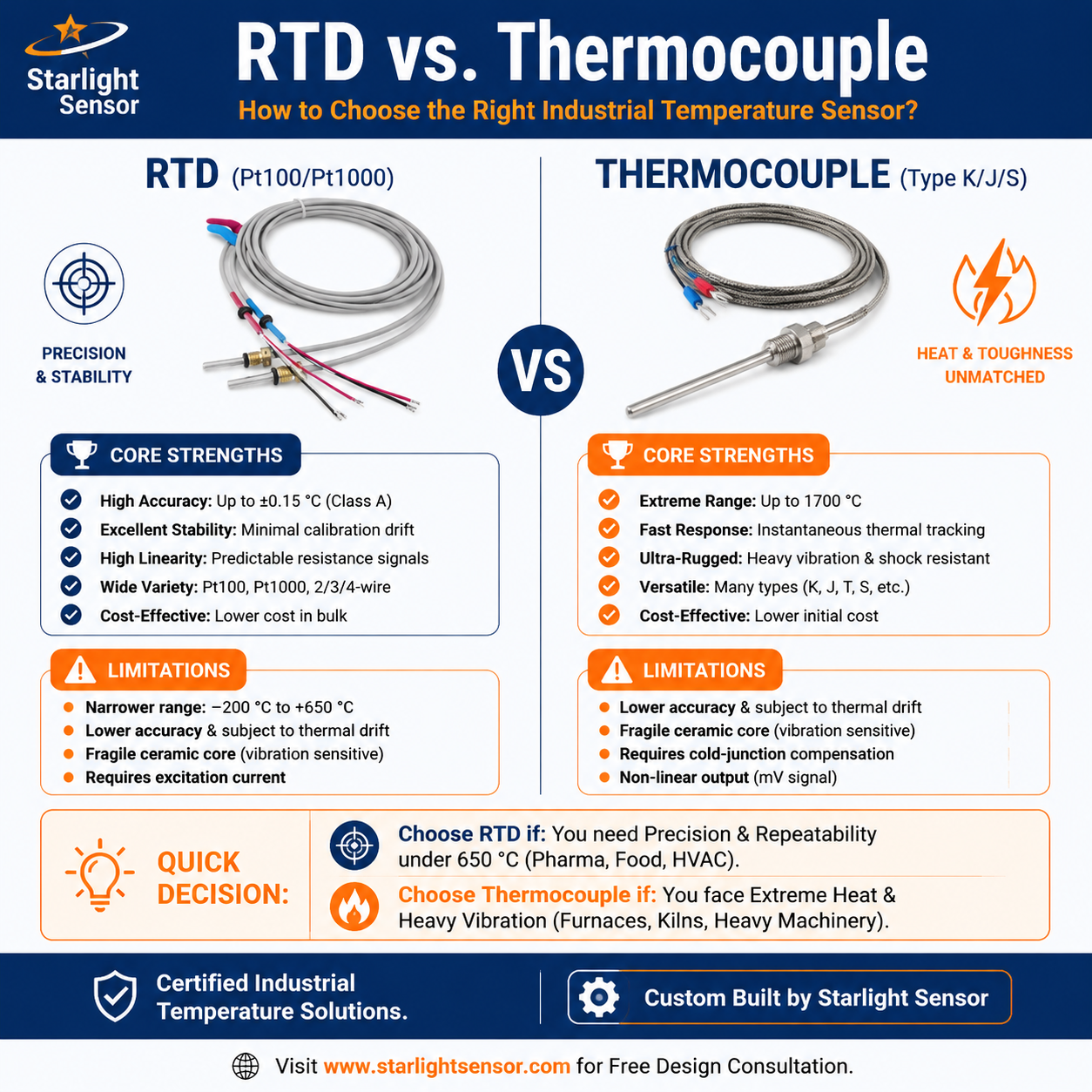
PT100 sensors are platinum resistance temperature detectors (RTD). Their resistance changes predictably with temperature. Because platinum offers excellent linearity and stability, PT100 sensors are widely used where precise temperature measurement is required.
In heat meters, PT100 sensors are commonly used to measure:
- Supply water temperature
- Return water temperature
- Temperature difference (ΔT)
- Thermal energy calculation inputs
The final heat consumption value depends heavily on the temperature difference between inlet and outlet. Even a small sensor mismatch can influence billing accuracy.
This is why many buyers search for:
- PT100 sensor for heat meter
- matched PT100 pair for heat meter
- EN1434 PT100 temperature sensor
- high accuracy RTD for heat meter
- PT100 heat meter supplier
These are real purchasing signals, not just informational searches.
Why Sensor Tolerance Matters More Than Many Buyers Think
Some buyers only compare unit price. Experienced buyers compare tolerance class, matching consistency, and drift performance.
PT100 tolerance defines how close the sensor reading is to the true temperature. In heat metering, tolerance matters because the system calculates energy from temperature difference, not only single-point temperature.
If one sensor reads slightly high and the other slightly low, the combined error becomes larger.
For example:
- Supply sensor +0.15°C
- Return sensor -0.15°C
Total differential error can reach 0.30°C.
In low ΔT systems, this becomes significant.
That means choosing the cheapest PT100 sensor may save cents today but create billing disputes and certification failures later.
Why Matched Sensor Pairs Are Critical for Heat Meters
For heat meter applications, two individually accurate sensors are not always enough. They should also be matched as a pair.
Matched PT100 pairs are selected and calibrated so both sensors respond consistently across operating temperature ranges.
Benefits include:
- Better differential temperature accuracy
- Improved repeatability
- Easier meter calibration
- Lower rejection rate during testing
- More stable field performance
Serious heat meter manufacturers usually request matched pair sensors rather than random standard sensors.
If a supplier cannot explain pair matching process, traceability, or batch consistency, that is a warning sign.
How PT100 Sensors Improve Heat Meter Accuracy in Real Projects
1. Stable Platinum Element Quality
Good PT100 performance starts with reliable platinum elements. Cheap inconsistent chips may pass initial test but drift later.
2. Precision Assembly
Lead welding, internal structure, filling material, and probe geometry all affect response consistency.
3. Tight Tolerance Selection
Class A, Class B, or tighter customized tolerance should match project requirement.
4. Pair Matching Process
Professional suppliers test and match two sensors together for differential measurement use.
5. Long-Term Moisture Protection
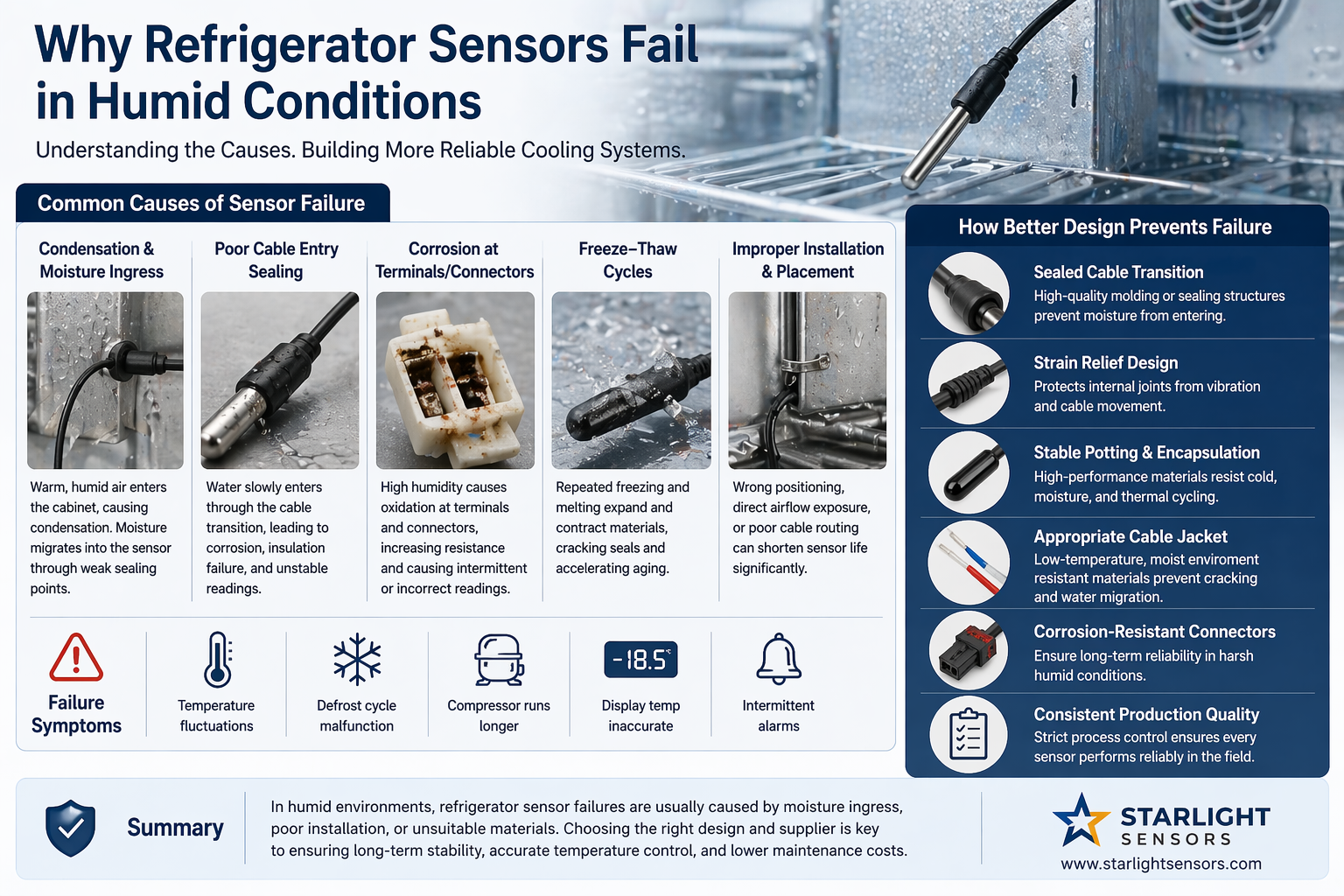
Water ingress, condensation, and cable degradation can shift resistance over time.
6. Repeatable Mass Production
A good sample means little if batch production varies.
Real buyers care about all six points.
Common Problems Caused by Low-Quality PT100 Sensors
Many low-price projects later suffer from:
- Calibration failure
- High batch rejection rate
- Billing complaints
- Field drift after installation
- Cable breakage during assembly
- Inconsistent response time
- Pair mismatch errors
These issues cost more than the original sensor price difference.
For OEM buyers, total project cost matters more than purchase price alone.
What Serious Buyers Usually Ask Before Ordering
Professional customers often ask these questions:
- Can you provide matched PT100 pairs?
- What tolerance class do you supply?
- Do you support EN1434 requirements?
- Can cable length and housing be customized?
- What is your batch consistency control process?
- Can you provide samples for validation?
- What annual volume can you support?
If you are buying for long-term production, these are the right questions.
PT100 Class A vs Class B for Heat Meters
Class B may be acceptable in some cost-sensitive projects. But for higher accuracy metering, many OEMs prefer Class A or tighter custom matched solutions.
A practical view:
- Class B: lower cost, entry-level projects
- Class A: better stability, stronger market competitiveness
- Matched tighter pair: premium metering and export projects
The right choice depends on market target, regulation level, and pricing strategy.
Why European and Export Buyers Focus on Consistency
Many EU and international buyers are less concerned about the cheapest quote. They focus on:
- Certification pass rate
- Stable supply chain
- Repeat orders without issues
- Low complaint rate
- Long-term cooperation
This is why consistent PT100 heat meter sensors often win more business than lowest-price offers.
How to Choose the Right PT100 Supplier
Look for suppliers who understand heat meter applications, not only general sensors.
Important indicators:
- Experience in metering projects
- Pair matching capability
- Stable resistance calibration process
- OEM customization support
- Export packing and documentation experience
- Responsive engineering communication
- Sample to mass production consistency
A supplier who only says “we can make PT100” is not enough.
Our Practical View from OEM Projects
In heat metering, the sensor is small, but its impact is large.
A few cents saved on tolerance may create thousands of dollars in downstream issues. Good buyers understand that meter reputation is built on long-term reading stability.
That is why more serious customers move from generic PT100 sourcing to application-specific PT100 solutions.
Looking for PT100 Sensors for Heat Meters?
If your project needs:
- Matched PT100 sensor pairs
- Class A / custom tolerance options
- EN1434-oriented solutions
- Customized housings, cables, connectors
- Stable OEM production supply
Working with an experienced manufacturer can shorten development time and reduce future risk.
Final Thoughts
Heat meter accuracy depends on more than electronics. It depends heavily on sensor quality, tolerance control, and pair consistency.
PT100 sensors improve heat meter accuracy when they are properly selected, properly matched, and consistently manufactured.
For real buyers, the right question is not “What is the cheapest sensor?” It is “Which sensor helps my meter perform reliably for years?”
That is where real long-term value begins.
For a broader comparison of sensing technologies, read our RTD vs thermocouple selection guide. To discuss matched sensor pairs for your meter, request a PT100 sensor application review with your drawings and measurement requirements.