Temperature measurement is essential in many industrial and commercial applications. Two of the most widely used temperature sensors are thermocouples and RTD sensors (Resistance Temperature Detectors).
Engineers and buyers often ask the same question:
Thermocouple vs RTD — which temperature sensor should you choose?
Understanding the difference between these two technologies helps ensure accurate temperature measurement, longer sensor life, and better performance for your application.
What Is a Thermocouple?
A thermocouple is a temperature sensor made by joining two different metal wires together. When the junction of these two metals is exposed to heat, a small voltage is generated. This voltage changes according to the temperature difference between the measurement point and the reference junction.
This effect is known as the Seebeck effect.
Thermocouples are extremely popular in industrial environments because they can measure very high temperatures and respond quickly to temperature changes.
Common thermocouple types include:
-
Type K thermocouple
-
Type J thermocouple
-
Type T thermocouple
-
Type N thermocouple
Among them, the K type thermocouple is the most widely used temperature sensor for industrial heating equipment, furnaces, ovens, and machinery.
Typical temperature range:
Key advantages of thermocouples include:
-
Wide temperature range
-
Fast response time
-
High durability in harsh environments
-
Lower cost compared to RTD sensors
Because of these benefits, thermocouples are commonly used in industrial furnaces, heaters, kilns, injection molding machines, and ovens.
What Is an RTD Temperature Sensor?
An RTD (Resistance Temperature Detector) measures temperature based on the change in electrical resistance of a metal element.
The most common RTD sensor is the PT100 temperature sensor, which uses a platinum sensing element with a resistance of 100 ohms at 0°C.
As temperature increases, the resistance of the platinum element increases in a very predictable and linear way. This allows RTD sensors to provide extremely accurate temperature measurements.
Typical temperature range for a PT100 sensor:
RTD sensors are widely used in:
-
laboratory equipment
-
industrial automation
-
pharmaceutical production
-
food processing systems
-
PLC temperature control systems
Their high stability makes them ideal for applications where precision and repeatability are critical.
Thermocouple vs RTD: Key Differences
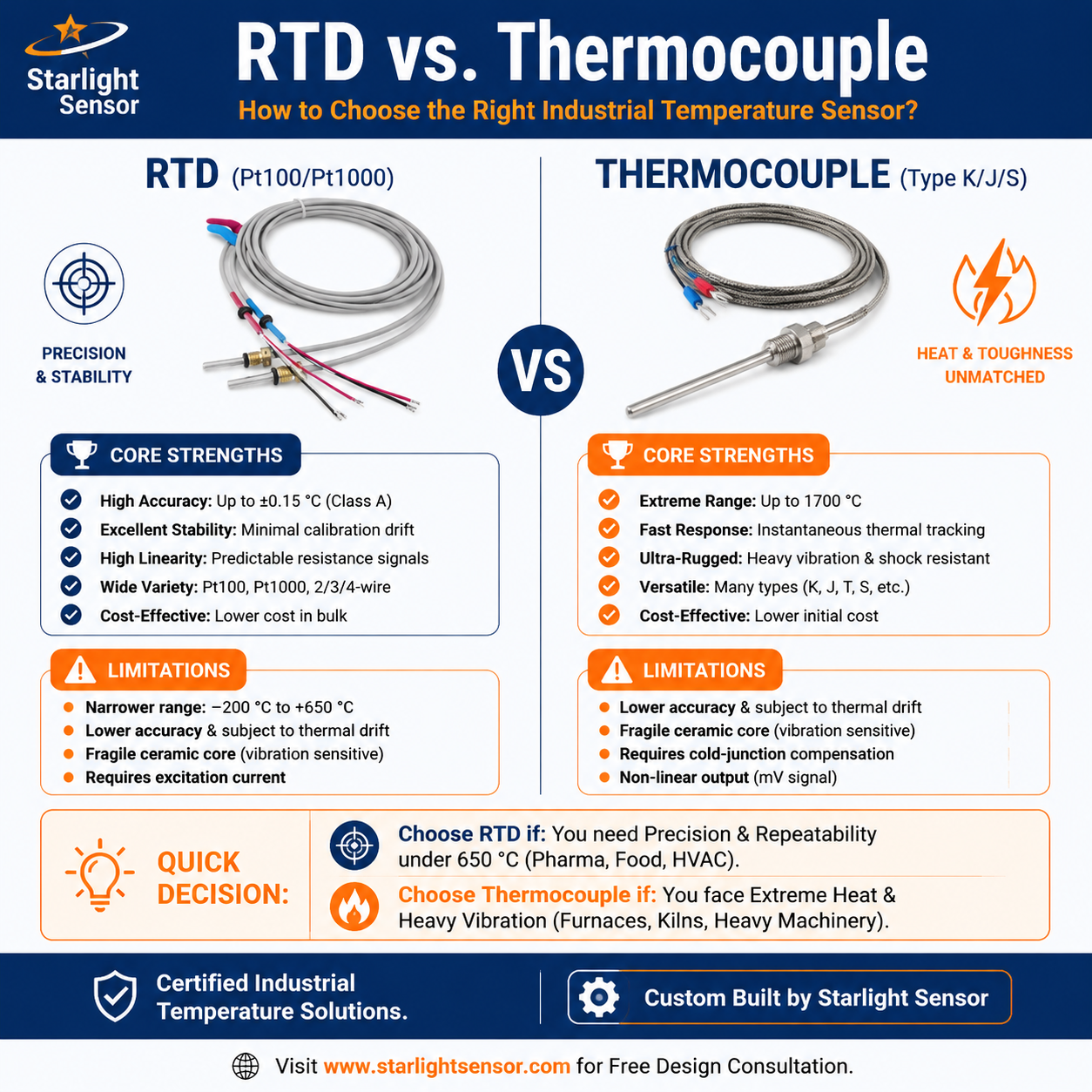
When comparing RTD vs thermocouple, several factors should be considered, including accuracy, temperature range, durability, and response time.
Temperature Range
Thermocouples can measure much higher temperatures than RTDs.
Typical comparison:
| Sensor | Temperature Range |
|---|---|
| Thermocouple | up to 1200°C or higher |
| RTD (PT100) | up to 500°C |
For high-temperature industrial applications, thermocouples are usually the better choice.
Accuracy
RTD sensors are generally more accurate than thermocouples.
A typical PT100 RTD accuracy may reach:
Thermocouples usually have lower accuracy:
For laboratory measurements or precise process control, RTD sensors are preferred.
Response Time
Thermocouples typically have a faster response time, especially when using exposed junction designs.
This makes thermocouples suitable for:
-
rapid temperature changes
-
dynamic heating processes
-
industrial ovens and burners
Durability
Thermocouples are mechanically stronger and can withstand:
-
vibration
-
high temperature shock
-
harsh industrial environments
RTD sensors, while accurate, are generally more delicate and are better suited for controlled environments.
When Should You Choose a Thermocouple?
A thermocouple temperature sensor is usually the best option when:
-
the temperature exceeds 500°C
-
fast response is required
-
the environment is harsh or vibrating
-
cost is a concern
Typical applications include:
-
industrial furnaces
-
metal processing
-
plastic extrusion machines
-
commercial ovens
-
heat treatment equipment
When Should You Choose an RTD Sensor?
An RTD temperature sensor, especially a PT100 probe, is ideal when:
-
high measurement accuracy is required
-
temperature stability is important
-
the environment is controlled
-
long-term repeatability is needed
Common applications include:
-
industrial automation systems
-
laboratory equipment
-
pharmaceutical production
-
food processing machinery
-
HVAC control systems
Conclusion
Both thermocouples and RTD sensors play important roles in modern temperature measurement systems.
In general:
-
Thermocouples are best for high-temperature and rugged industrial environments.
-
RTD sensors provide higher accuracy and stability for precision applications.
Choosing the right sensor depends on your temperature range, required accuracy, and installation conditions.
For many industrial users, combining both technologies allows optimal temperature monitoring across different parts of the process.