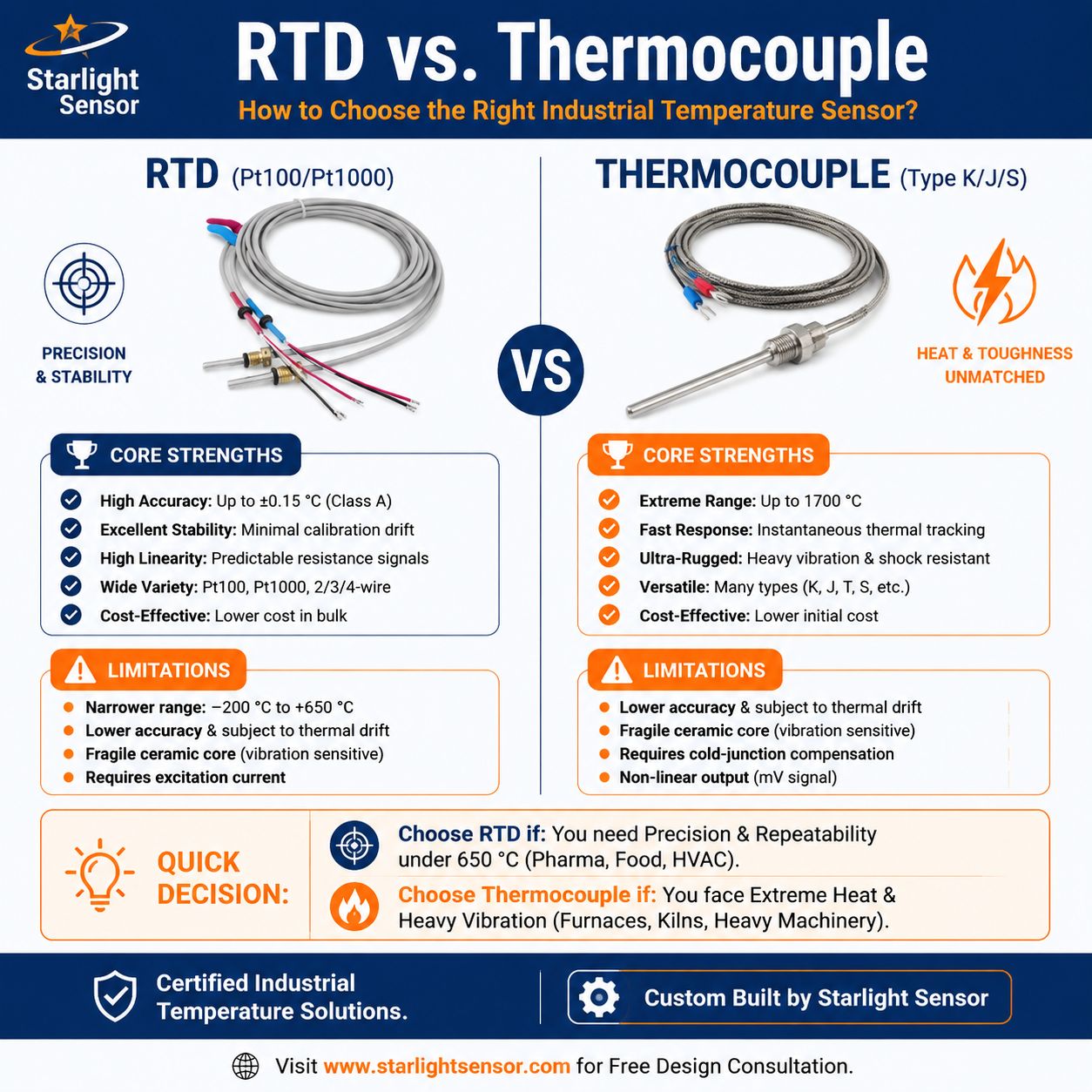
ADS1115 with PT100 and NTC Sensors: What the Measurement Circuit Needs
The ADS1115, a PT100 RTD, and an NTC thermistor are separate components that can appear in a temperature-measurement system. They do different jobs: a PT100 or NTC responds to temperature by changing resistance, while the ADS1115 converts an analog voltage presented at its input into a digital value. The ADC alone does not make a sensor system accurate; the excitation, signal-conditioning circuit, wiring, calibration, and firmware also matter.
This guide explains the roles of these components and the design checks an engineering team should make before choosing a measurement circuit. It is general application guidance, not a claim that StarLight supplies or integrates an ADS1115-based assembly.

What the ADS1115 does
The ADS1115 is a 16-bit, I²C-compatible analog-to-digital converter from Texas Instruments. It measures differential or single-ended input voltage within the limits and operating conditions in its datasheet. It does not directly measure temperature or resistance. A circuit must first convert a sensor’s resistance change into a suitable voltage, and the input signal must remain within the ADC’s permitted range.
Resolution is only one part of system performance. Reference and excitation stability, resistor tolerance, input noise, layout, sensor tolerance, self-heating, calibration, and the chosen conversion curve can all affect the final temperature result. Do not infer a temperature accuracy from ADC bit count alone.
PT100 and NTC sensors are different
A PT100 is a platinum resistance temperature detector (RTD) with a nominal resistance of 100 ohms at 0°C. An NTC thermistor is a semiconductor sensor whose resistance generally decreases as temperature rises. Their resistance ranges, response curves, excitation requirements, and conversion methods differ, so each needs a circuit designed for that sensor and its operating range.
For an RTD, the design needs an excitation method and a way to account for lead-wire resistance when required. For an NTC thermistor, a divider or another suitable resistance-measurement circuit is commonly used; the selected pull-up resistor, sensor R/T curve, and conversion method should match the intended range. In either case, verify the complete signal chain rather than treating the ADC and sensor as a single component.
Design checks before using an ADS1115
- Confirm the sensor type, nominal resistance, tolerance, R/T curve or RTD standard, and required temperature range from the exact sensor documentation.
- Design the excitation and signal-conditioning circuit for that sensor. Check input common-mode and differential limits, supply conditions, and expected voltage over the full range against the ADS1115 datasheet.
- Estimate the effects of lead resistance, component tolerances, noise, filtering, grounding, and sensor self-heating.
- Define how raw ADC readings will be converted to resistance and then to temperature, including calibration and fault detection.
- Validate the assembled system against a traceable reference at representative temperatures and operating conditions before using performance figures in a specification.

Choosing a sensor for an OEM project
Start with the measurement point and environment: temperature range, response time, immersion or contact method, moisture and vibration exposure, available space, cable length, connector, and controller input. Then compare the sensor curve and tolerance with the electronics and calibration plan. A suitable sensing element and a suitable readout circuit must be selected together.
StarLight Sensors offers temperature-sensor and probe options for OEM evaluation. Explore the NTC sensor range and RTD temperature sensor range. For a project review, share the application, temperature range, probe dimensions, cable and connector requirements, and target quantity through the request-a-quote page.
Technical references
- Texas Instruments ADS1115 datasheet — device functions, input limits, and operating conditions.
- Analog Devices RTD system design article — RTD excitation and measurement-system considerations.

Conclusion
The ADS1115 is an ADC, while a PT100 and an NTC thermistor are distinct resistance-based sensing elements. Either sensor may be read by an appropriate analog front end, but the circuit, conversion method, and validation must be designed for the chosen sensor. Review the datasheet and verify the complete system before making accuracy or application claims.