Exploring the Versatility of the Y60 Series RTD Temperature Sensors
In the realm of new energy applications, precision and reliability are paramount.

In the realm of new energy applications, precision and reliability are paramount.

In today’s world, electrical parts are everywhere, powering everything from everyday household gadgets to complex industrial machinery. Whether we realize it or not, electrical components make the world go round. The electrical parts manufacturing business has become an indispensable pillar of the modern economy, serving industries ranging from consumer electronics to renewable energy, automotive, and beyond. But how did this business become so important, and why is it booming today? Let’s take a closer look. The Role of Electrical Parts in Modern Society Electrical parts include a vast range of components such as wires, resistors, capacitors, circuit boards, transformers, connectors,

In recent years, the global heat meter market has experienced significant growth driven by rising demand for energy efficiency, expanding district heating systems, and increasingly stringent government regulations aimed at reducing carbon emissions. Heat meters, used to measure thermal energy consumption in residential, commercial, and industrial settings, are critical for optimizing energy use and ensuring accurate billing. As of May 19, 2025, Europe—particularly Nordic countries and Germany—leads in heat meter production, followed by China, with the U.S. also playing a notable role. This article explores the current state of heat meter production, highlights key regions, forecasts future trends, and introduces

Selecting an industrial temperature sensor is a critical decision for ensuring precision, reliability, and system compatibility in applications such as HVAC, petrochemical processing, automotive testing, and industrial automation. With options ranging from NTC thermistors to thermocouples and RTDs, engineers and procurement specialists must evaluate technical specifications, environmental factors, and integration requirements. This technical guide from Starlight Sensors outlines key considerations for choosing an industrial temperature sensor, providing actionable insights to optimize performance in demanding environments. Why Sensor Selection Impacts Industrial Performance Industrial temperature sensors are the backbone of process control, providing real-time data for monitoring and regulation. An unsuitable sensor
In modern HVAC systems, temperature sensors play a critical role in ensuring energy efficiency, performance stability, and user comfort. Among them, NTC (Negative Temperature Coefficient) thermistors are the most widely adopted due to their high sensitivity and cost-effectiveness. This article explores the common types of NTC temperature sensors used in indoor and outdoor air conditioning units, the underlying manufacturing processes, and how to address common failure modes to ensure long-term reliability. 🔧 Common Types of NTC Temperature Sensors In air conditioners, NTC sensors are typically categorized based on their application environment: Indoor Sensors: Operate in relatively stable environments and are

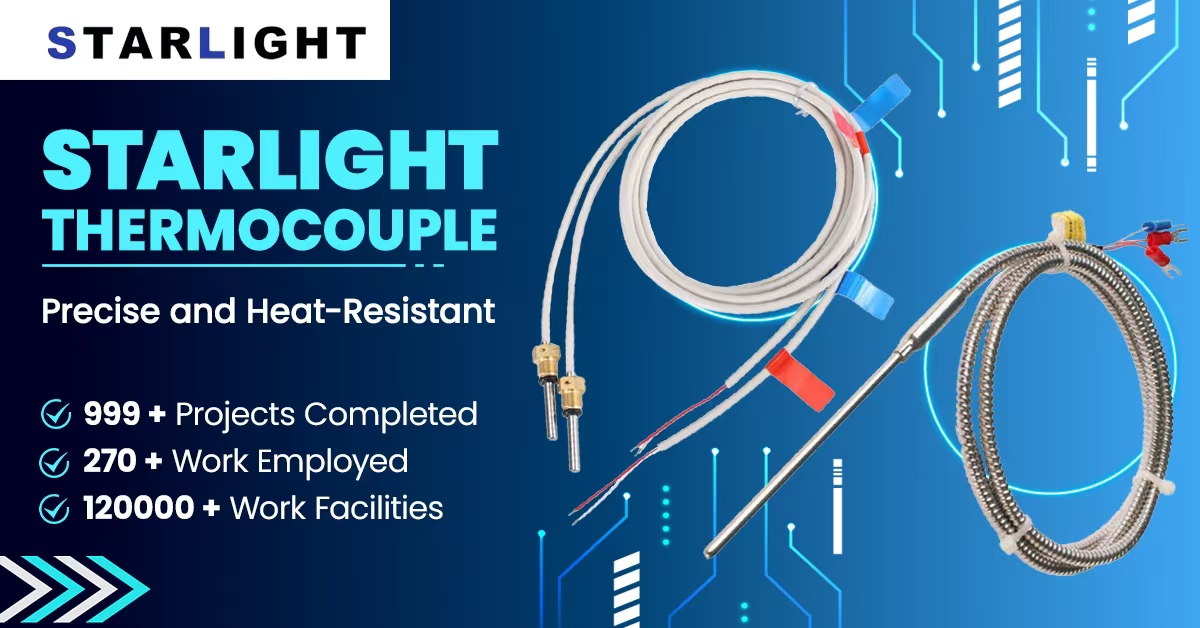
Thermocouples are indispensable tools in temperature measurement, renowned for their versatility and durability across a vast range of applications—from everyday kitchen appliances to the intense environments of industrial kilns. This article delves into the various types of thermocouples, their specific applications, and how manufacturers like Starlight, a leading Chinese producer, are innovating to meet diverse industry needs. Understanding Thermocouples A thermocouple consists of two dissimilar metal wires joined at one end, known as the sensing junction. When this junction experiences a change in temperature, it generates a voltage that can be interpreted to determine the temperature. This simple yet effective

Thermocouples are indispensable tools in temperature measurement, renowned for their versatility and durability across a vast range of applications—from everyday kitchen appliances to the intense environments of industrial kilns. This article delves into the various types of thermocouples, their specific applications, and how manufacturers like Starlight, a leading Chinese producer, are innovating to meet diverse industry needs. Understanding Thermocouples A thermocouple consists of two dissimilar metal wires joined at one end, known as the sensing junction. When this junction experiences a change in temperature, it generates a voltage that can be interpreted to determine the temperature. This simple yet effective

In today’s interconnected world, the demand for precise and reliable temperature monitoring has never been higher. Waterproof temperature sensors, particularly those utilizing TPE (Thermoplastic Elastomer) and NTC (Negative Temperature Coefficient) technologies, are at the forefront of this revolution. These sensors are transforming industries such as refrigeration, freezers, aquariums, and IoT devices by offering unparalleled accuracy, durability, and adaptability. Understanding Waterproof TPE/NTC Sensors Waterproof TPE/NTC sensors are designed to operate in challenging environments where moisture and temperature fluctuations are common. The TPE material provides flexibility and resistance to water ingress, while the NTC thermistor ensures accurate temperature readings. These sensors are

In today’s rapidly evolving industrial landscape, precision temperature monitoring is more important than ever. Off-the-shelf sensors often fail to meet the unique demands of specialized applications, leading to inefficiencies, inaccuracies, and reduced equipment lifespan. This is where custom temperature sensors come into play — offering tailor-made solutions that elevate performance, reliability, and even competitive advantage. The Limitations of Standard Temperature Sensors Standard sensors are designed for general-purpose use, but industrial environments are rarely standard. From extreme heat and vibration to corrosive atmospheres and compact installation spaces, specialized applications require more than a one-size-fits-all approach. Why Custom Temperature Sensors Matter? Custom

When it comes to measuring temperature in various applications, selecting the right sensor is critical for achieving precision, reliability, and efficiency. Among the most popular options are PT100 sensors, thermocouples (such as the Type K thermocouple), and NTC sensors. Each of these has unique characteristics that make it suitable for specific scenarios. This article explores the differences between these sensors, including their strengths and weaknesses, and provides insights into their practical use with keywords like high accuracy temperature sensor, Type K thermocouple for industrial use, how to calibrate PT100 sensor, and NTC temperature sensor datasheet. Understanding PT100 Sensors A PT100
© Copyright 2024 – Starlightsensors