Choosing an NTC thermistor for commercial freezers starts with the operating environment. This guide helps OEM engineers and procurement teams review moisture protection, encapsulation, and supplier test data when selecting a freezer temperature sensor.
A freezer that fails to hold temperature may have a sensor problem as well as other possible causes. Reviewing the sensor assembly and its operating conditions is part of a complete troubleshooting process.
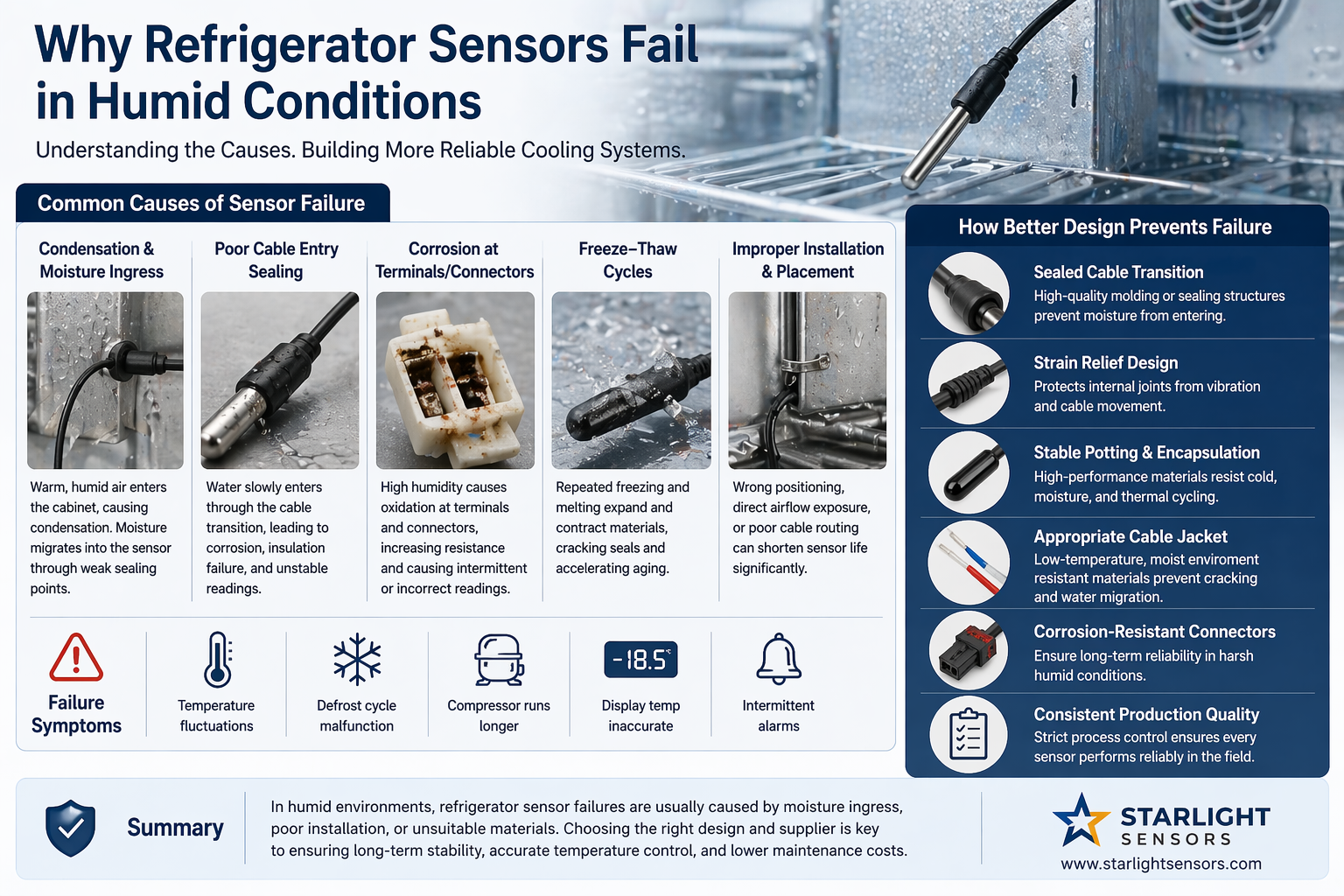
In commercial refrigeration, moisture ingress (water vapor penetration) is the number one killer of NTC thermistors. Because freezers undergo constant defrost cycles, temperature fluctuations create a harsh vacuum effect, forcing moisture into the sensor probe.
Once moisture gets inside, the insulation resistance drops, leading to thermal drift (inaccurate readings) or a complete short circuit.
How do you stop this? How do you choose an NTC thermistor that survives the brutal, high-humidity environment of commercial freezers? Let’s dive into the technical details.
1. Understand the Root Cause: Why Do Freezer Sensors Leak?
To fix the problem, we must understand the physics behind it. A commercial freezer is a battlefield for electronics.

During the defrost cycle, the temperature rises rapidly, causing the tiny amount of air inside the sensor probe to expand. When the compressor kicks back on, the temperature drops, the air contracts, and a micro-vacuum effect is created.
This vacuum literally sucks moisture, condensation, and water drops through the tiniest microscopic gaps between the cable jacket and the encapsulating material. If the sensor uses standard epoxy-filled encapsulation, it is only a matter of time before the moisture breaks through the seal.
2. Epoxy vs. Over-Molding: The Material Matrix
When sourcing NTC thermistors for commercial refrigeration, the encapsulation method and material selection make all the difference. There are two primary types in the market:
A. Epoxy Resin Filled Sensors (The Standard Choice)
Many standard sensors use a copper or stainless steel tube filled with epoxy resin to seal the NTC chip. While common, epoxy has a major flaw: Thermal Expansion Mismatch.
Stainless steel, epoxy resin, and PVC cables expand and contract at completely different rates when subjected to thermal shock (moving from -40 degree to +40 degree). Over time, micro-gaps appear between the epoxy and the metal shell. Moisture enters seamlessly.
B. Double-Injection Over-Molded Sensors (The Premium Choice)
For commercial freezers and demanding floor-heating environments, Double-Injection Over-molding (TPE or Thermoplastic Elastomer) is the gold standard

Instead of potting resin into a metal tube, the NTC thermistor chip and the cable are chemically fused and over-molded with TPE material as a single, continuous piece. Because the cable jacket and the probe housing are made of the same elastic material family, they melt together during production, creating a 100% homogenous bond with zero joints or air gaps.
3. Key Technical Parameters for Heavy-Duty Freezer Applications
When evaluating data sheets from sensor manufacturers, do not just look at the R25 resistance (10K/100K) and B-value (3435K/3950K). Different temperature sensors have distinct technical bounds, as shown below:
To avoid moisture ingress in refrigeration applications, look for these specific testing standards on your supplier’s datasheet:
1. Waterproof Rating: Demand IP68
Do not settle for IP67. Commercial refrigeration requires IP68. This means the sensor must be capable of continuous immersion in water under specified conditions without failing.
2. Insulation Resistance (The True Quality Test)
Ask your supplier for their insulation resistance data after water immersion. A high-quality NTC sensor should maintain an insulation resistance of > 100 MΩ under 500V DC even after being submerged in ice water for weeks. If insulation drops, moisture has already started entering.
3. Thermal Shock Resistance
A reliable freezer sensor should easily pass a Thermal Shock Test: 100 to 500 cycles of rapid moving between −40°C and +80°C. If the sensor’s resistance drifts by more than ΔR25/R25 > 1% after this test, it will fail in your freezer within a short period.
Conclusion: Focus on Total Cost of Ownership
Buying a non-waterproof, low-end sensor might save a few pennies during the initial procurement phase, but it will cost your company significantly in warranty claims, field replacements, and damaged brand reputation. In the commercial cooling and specialized heating industry, reliability is your greatest cost-saver.
For commercial freezers, cold storage rooms, and high-end floor heating systems, always specify IP68 Double-Injection TPE Over-molded NTC sensors.
Eliminate Sensor Failures in Your System Designs
Are you tired of dealing with customer complaints regarding inaccurate temperature readings, icing issues, or sensor short-circuits caused by moisture ingress?
At Starlight Sensors, we specialize in engineering high-reliability, zero-moisture-leakage NTC thermistors and magnetic switch solutions designed specifically for harsh, humid environments.
Why Partner with Us?
- 100% Customized Engineering: We don’t just sell catalog items. We custom-manufacture wire lengths, specific connector types (Molex, JST, Tyco), and probe shapes to fit seamlessly into your evaporator coils, commercial kennels, or floor heating panels.
- Direct Engineering-to-Engineering Support: We are a flexible, direct-to-engineering manufacturing center. You talk directly with our application engineers for quick turnarounds and fast modification without corporate bureaucracy.
- Proven IP68 Reliability: Our double-injection TPE temperature probes are tested to withstand thousands of aggressive defrost cycles without a single drop of water ingress.
Get Your Technical Assessment & Custom Solutions
Don’t let an unstable sensor compromise your high-end equipment. Contact our technical team today to discuss your project requirements, share your technical drawings, or request customized samples for your bench benchmarking tests.
For a broader selection checklist covering measurement location, response time, and controller compatibility, read our commercial refrigeration temperature sensor guide. To discuss a sensor assembly for your equipment, request a custom NTC sensor review with your application requirements and drawings.