Evaporator Temperature Sensors
Evaporator sensors operate close to the cooling coil, where temperature changes can be rapid and moisture exposure is common.
These sensors are frequently used to monitor evaporator conditions and support defrost control.
A suitable evaporator sensor should offer reliable thermal contact, appropriate response time, and protection against moisture.
Defrost Temperature Sensors
During defrost cycles, the refrigeration system experiences repeated temperature changes and condensation.
The sensor must provide consistent feedback so the controller can determine when defrosting should end or when normal cooling operation should resume.
Poor thermal contact, incorrect positioning, or moisture damage may lead to inaccurate temperature readings and inconsistent defrost performance.
The important lesson is simple: one sensor design is not necessarily suitable for every measurement point.
2. Waterproofing Is More Than an IP Rating
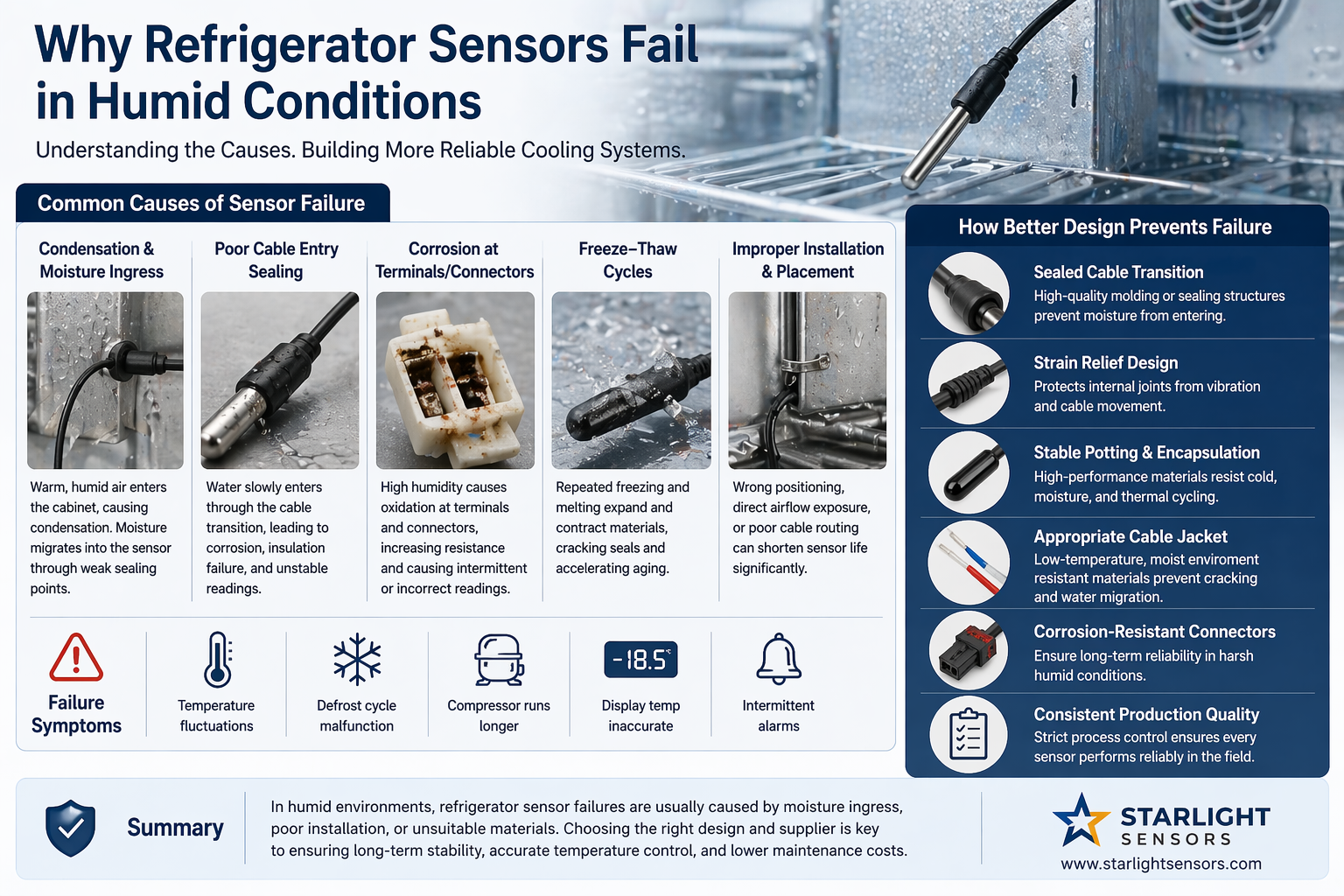
Moisture is one of the most common challenges for temperature sensors used in commercial refrigeration.
Sensors may be exposed to condensation, frost, cleaning processes, and repeated cooling and heating cycles.
IP67 and IP68 ratings can help describe the level of protection provided by a sensor enclosure under specified test conditions.
However, an IP rating alone does not guarantee long-term reliability in every refrigeration application.
Manufacturers should also consider:
- The sealing structure between the probe and cable
- The compatibility of encapsulation materials
- Cable jacket resistance to the operating environment
- Repeated thermal expansion and contraction
- Moisture migration along cable interfaces
For example, a sensor may initially pass a water immersion test but develop sealing problems after repeated temperature cycling.
This is why waterproofing should be evaluated as part of the complete sensor assembly rather than as an isolated specification.
For demanding refrigeration applications, customized sealing structures and appropriate material selection can help improve durability.
3. Response Time Matters in Real Operating Conditions
Temperature sensor accuracy is important, but response time can be equally relevant.
Response time describes how quickly a sensor reacts to a change in temperature.
In many technical specifications, the time constant refers to the time required for a sensor to reach approximately 63.2% of a defined temperature step under specified test conditions.
However, response time depends on more than the sensing element.
It can also be influenced by:
- Probe diameter and wall thickness
- Housing material
- Thermal conductivity of the filling compound
- Contact between the sensor and the measured surface
- Whether the measurement is performed in air, liquid, or against a solid surface
A smaller probe may respond faster under certain conditions, while a larger stainless steel housing may offer greater mechanical protection.
Neither design is automatically better.
The correct choice depends on the operating environment and the requirements of the refrigeration controller.
For OEM projects, response time should be evaluated using clearly defined test conditions that represent the intended application as closely as practical.
4. Sensor and Controller Compatibility Is Essential
Commercial refrigeration systems rely on the interaction between temperature sensors and electronic controllers.
Even a mechanically suitable sensor may not work correctly if its electrical characteristics are incompatible with the controller.
For NTC thermistors, important parameters include nominal resistance, resistance tolerance, and B-value or the specified resistance-temperature curve.
For example, two sensors may both be described as 10kΩ NTC thermistors but have different resistance-temperature characteristics.
Using an incorrect sensor curve can result in temperature measurement errors.
RTD sensors, including PT100 and PT1000, are also used in applications where their characteristics match the measurement system’s requirements.
Before selecting or replacing a sensor, manufacturers should confirm:
- Sensor type and resistance-temperature characteristics
- Operating temperature range
- Accuracy and tolerance requirements
- Controller input compatibility
- Cable length and wiring configuration
- Connector type and pin arrangement
For replacement or alternative supplier projects, matching the existing sensor’s electrical specifications is particularly important.
A lower-cost component is not a suitable alternative unless it also meets the system’s functional requirements.
5. Mechanical Design and Installation Should Not Be Overlooked
Temperature sensors must fit the physical design of the refrigeration equipment.
In practice, mechanical requirements can be just as important as electrical specifications.
An OEM manufacturer may need a particular probe diameter, cable exit direction, mounting clip, connector, or protective housing.
For example, an evaporator sensor may need to fit securely into a narrow installation space while maintaining effective thermal contact.
A cabinet sensor may require a different mounting method to simplify assembly and protect the sensing element.
Cable routing is another important consideration.
Incorrect cable length, unsuitable insulation, or incompatible connectors can increase installation time and create unnecessary production difficulties.
This is why customized sensor assemblies are often more practical than purchasing a standard sensing element and adapting it during equipment assembly.
A complete solution may include the temperature sensing element, protective probe, cable, connector, and mounting structure.
6. What Should OEM Manufacturers Consider When Evaluating a New Sensor Supplier?
For refrigeration equipment manufacturers, changing or adding a temperature sensor supplier requires more than comparing quotations.
A reliable supplier should be able to understand the application, review technical drawings, and support product evaluation.
Several questions are worth considering.
Can the supplier match the existing specifications?
For alternative sourcing, the first step is to confirm electrical, mechanical, and environmental requirements.
Can the supplier support customization?
Different refrigeration equipment models may require variations in probe dimensions, cable lengths, connectors, or installation methods.
Can samples be provided for evaluation?
Prototype testing allows engineers to check fitment, temperature measurement performance, sealing, and compatibility before mass production.
Is production consistency controlled?
Stable resistance characteristics, assembly quality, and sealing performance are important for repeatable results.
Can the supplier support both small trials and volume production?
An effective development process should allow technical evaluation before committing to larger quantities.
The objective is not simply to find the cheapest sensor.
It is to establish a reliable component solution that works consistently within the finished refrigeration equipment.
7. Customized Temperature Sensor Assemblies for Commercial Refrigeration
At Starlight Sensors, we focus on customized temperature sensing solutions for OEM and industrial applications.
Our product range includes NTC temperature sensors, PT100/PT1000 RTD sensors, waterproof temperature probes, and customized cable and connector assemblies.
For commercial refrigeration projects, we can support sensor designs intended for cabinet temperature monitoring, evaporator measurement, and defrost control.
Depending on project requirements, customization may include:
- Sensor resistance and temperature characteristics
- Stainless steel or other suitable probe housings
- Probe dimensions and mounting structures
- Waterproof encapsulation
- Cable materials and lengths
- Connector and terminal configurations
We also support sample evaluation and small-batch requirements, helping customers assess technical suitability before moving toward volume production.
Our approach is to understand the customer’s application first, then work toward a sensor assembly that meets the required specifications.
Conclusion: The Right Sensor Is Part of the Complete Refrigeration Solution
In commercial refrigeration, reliable temperature measurement depends on the complete relationship between the sensing element, probe structure, installation environment, and electronic controller.
Accuracy is important, but it is only one part of the selection process.
Waterproofing, response time, electrical compatibility, mechanical fitment, and production consistency all deserve attention.
For refrigeration equipment OEMs and control system manufacturers, selecting the right temperature sensor can help reduce integration problems and support more dependable system operation.
Looking for customized temperature sensors for your refrigeration equipment or controller?
Starlight Sensors supports OEM projects with NTC and RTD temperature probes, waterproof assemblies, and customized cable and connector solutions.
We welcome technical discussions, drawings, and sample evaluation requirements.