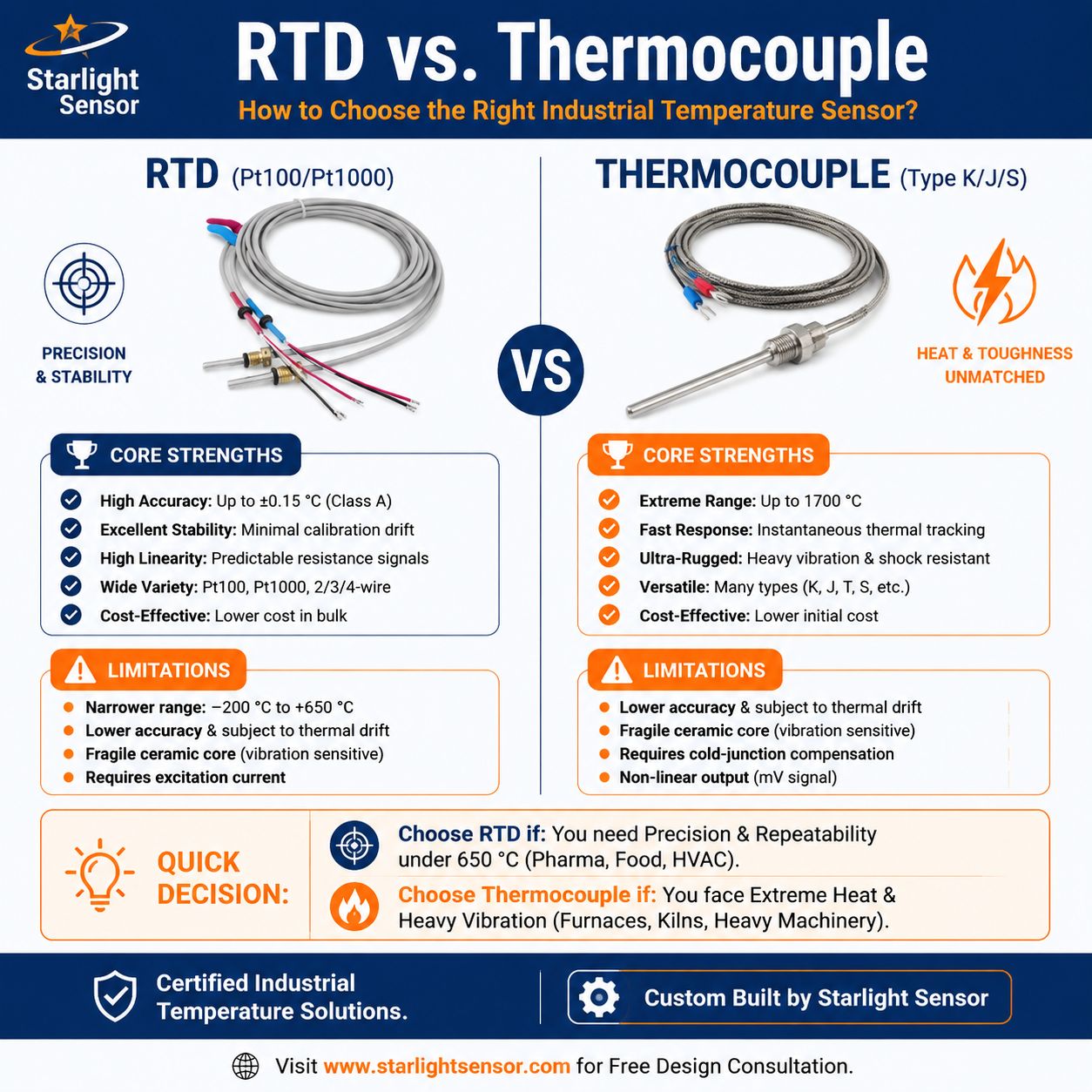
The name “MCR PT100” is sometimes described online as an NTC sensor, but that wording mixes two different technologies. A PT100 is a platinum resistance temperature detector (RTD); an NTC thermistor is a semiconductor resistor whose resistance falls as temperature rises. Confirm the exact construction and datasheet for the model you are sourcing before comparing performance.

What does PT100 mean?
For a nominal PT100 element, “100” denotes a resistance of 100 Ω at 0 °C. Its resistance changes predictably with temperature, allowing a compatible measuring instrument to calculate temperature. IEC 60751:2022 covers industrial platinum resistance thermometers and platinum temperature sensors; the standard and the product datasheet should be checked for the applicable resistance–temperature relationship and tolerance class. The PT100 name alone does not specify the probe’s sheath, wiring, accuracy class, response time, pressure rating, or usable range.
See the RTD vs. thermocouple selection guide for a broader comparison of industrial sensor technologies.

PT100 RTD vs. NTC thermistor
Both technologies infer temperature from electrical resistance, but they use different sensing materials and resistance curves. Platinum RTDs are commonly selected when a project needs a standardized platinum resistance relationship and a stable measurement system. NTC thermistors provide a strongly nonlinear resistance change and are often selected for compact, application-specific sensing. Actual accuracy, stability, response, and operating limits depend on the sensor assembly, measuring circuit, calibration, installation, and stated test conditions—not on the technology label alone.
- Choose a PT100 RTD when the controller supports the required platinum curve and the project needs the specified RTD tolerance and wiring arrangement.
- Choose an NTC thermistor when the circuit can use the selected R/T curve and the required temperature interval, tolerance, and response have been validated.
For another PT100 use case, review our guide to PT100 sensors for heat-meter measurements.
What OEM buyers should confirm
Before requesting a quote, define the complete measuring assembly and operating conditions. Ask the supplier to confirm the following against the exact part number:
- Nominal resistance and applicable resistance–temperature curve or standard
- Tolerance class and test or calibration conditions
- Two-, three-, or four-wire connection and controller compatibility
- Probe dimensions, sheath material, process connection, cable, and connector
- Required operating range, media, vibration, moisture, pressure, and response-time test method
- Traceability, inspection records, and any application-specific validation requirements
Do not assume a temperature limit, accuracy class, environmental rating, or industry certification from the “PT100” designation. Confirm each requirement in the model-specific datasheet and qualification records.

Request a PT100 sensor quote
Share your target resistance curve, tolerance, wiring, probe dimensions, process conditions, and validation needs so the supplier can assess the right configuration. Contact Starlight Sensors for an OEM temperature-sensor inquiry.

About Starlight Sensors
Starlight Sensors develops and supplies temperature-sensing solutions, including platinum resistance temperature sensors, NTC thermistors, thermocouples, and temperature and humidity sensors. For a project-specific recommendation, provide the operating conditions and required test criteria with your inquiry.
Technical reference: IEC 60751:2022 — Industrial platinum resistance thermometers and platinum temperature sensors.