Acoustic gas thermometry is a specialized method for determining the thermodynamic temperature of a gas from the speed of sound. It is a metrology technique built around a controlled gas sample and resonant cavity, not a generic drop-in sensor for measuring the surface temperature of an object. This distinction matters when comparing temperature measurement methods for a product or process.
How acoustic gas thermometry works
In a dilute monatomic gas, the speed of sound is related to thermodynamic temperature. A primary acoustic gas thermometer measures acoustic resonance frequencies in a cavity containing a characterized gas, then uses the sound-speed relationship to determine temperature. The result depends on the gas composition and purity, cavity dimensions and thermal expansion, pressure and frequency corrections, and the measurement system.
NIST describes using argon in a nearly spherical resonator and comparing acoustic resonance measurements at an unknown temperature with measurements near a reference temperature. The method supports high-accuracy thermometry research and helps improve temperature standards; it is a specialized laboratory approach with substantial measurement-system requirements.
What it does—and does not—measure
The measurement is tied to the gas in the resonator. It should not be described as a general-purpose non-contact surface thermometer, nor should broad claims about fast response, wide operating range, immunity to electromagnetic interference or healthcare use be assumed without a specific validated instrument and evidence. A device measuring sound speed in a process gas may infer gas temperature under its own calibrated conditions, but that is a different application from measuring an object’s surface.
When to consider this technique
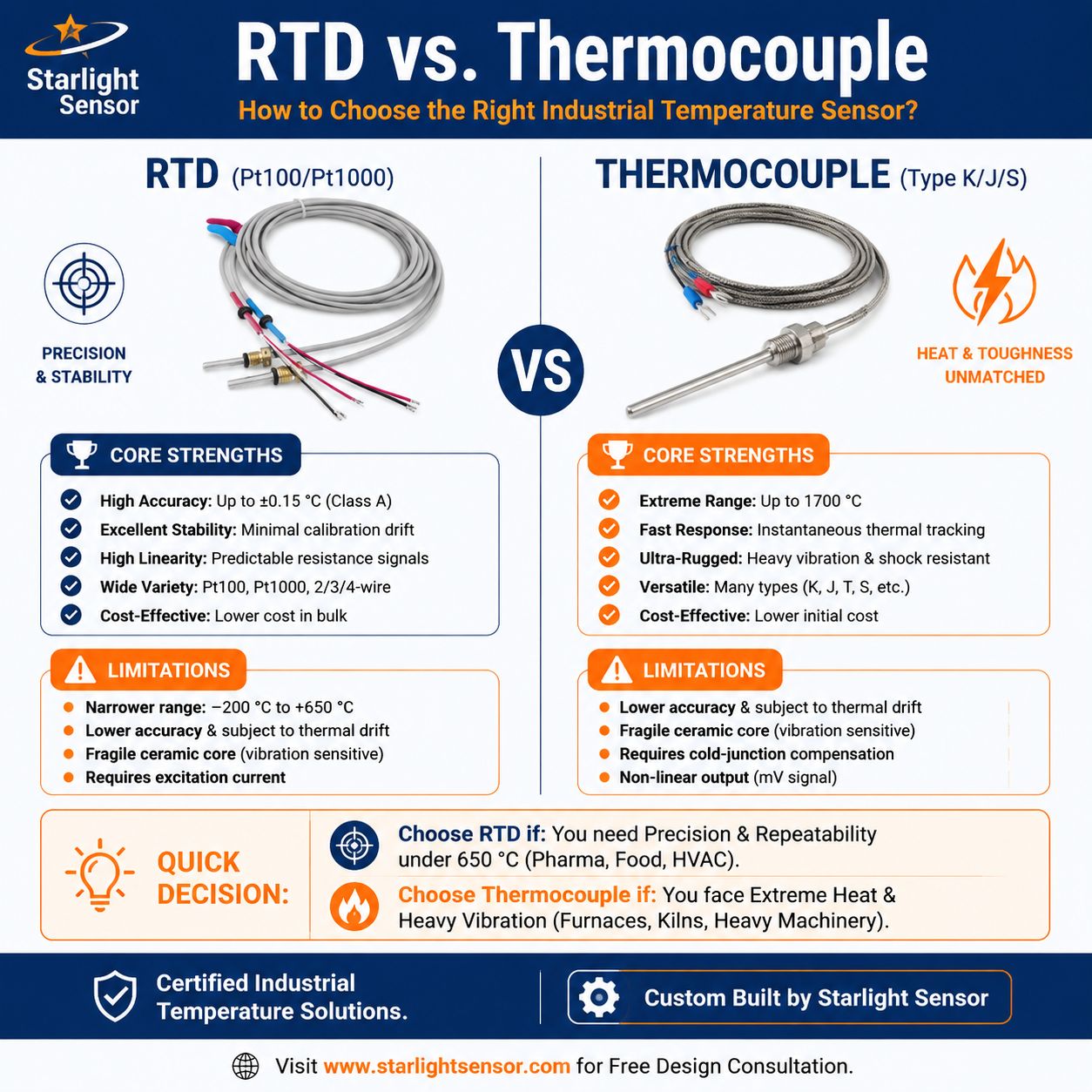
Acoustic gas thermometry is relevant to primary thermometry, metrology research and temperature-scale realization, where uncertainty, traceability, gas properties and resonator behavior are carefully controlled. For routine equipment temperature sensing, engineers more commonly compare contact probes such as RTDs, thermocouples and thermistors against the application’s temperature range, accuracy, response, mounting, environment and input electronics.
See our RTD vs. thermocouple selection guide for conventional industrial probe tradeoffs. For an OEM temperature probe review, provide the measured medium or surface, operating range, required accuracy, installation details, controller input and validation criteria through our RFQ page.
Further reading: NIST Acoustic Thermometry and NIST’s review of acoustic gas thermometry.