A flexible temperature sensor probe can refer to several constructions, from a bendable sheathed probe to a thin, conformable assembly. Specify the intended bend, mounting, measurement point, sensor element, and operating conditions before choosing a design. Confirm the minimum bend radius, whether forming is allowed after manufacture, and which parts of the assembly can flex.
Define what must flex
Show the installation path, bend location and radius, available space, contact surface, insertion depth, and movement during service. Distinguish a probe that is shaped once during installation from one that must flex repeatedly in operation. Cable flexibility does not mean the sensing tip or sheath can be bent without limits.
Match the element to the readout
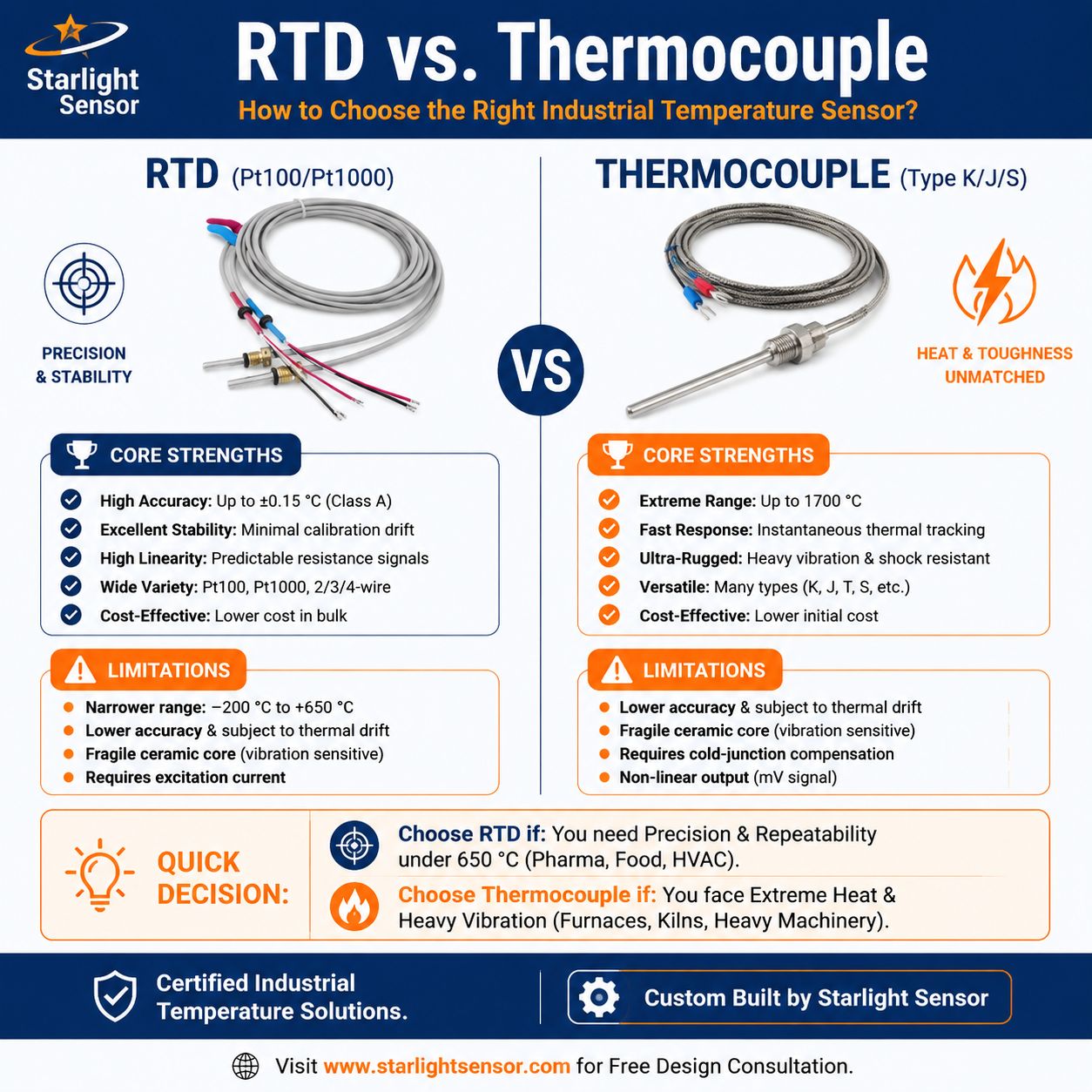
Identify the required sensor type and controller input. An NTC requires its resistance curve and conversion; an RTD requires the specified Pt100/Pt1000 and wiring; a thermocouple needs the correct type, extension wire, and cold-junction compensation. Confirm tolerance, temperature span, response needs, electrical isolation, and readout compatibility for the complete design.
Balance flexibility with protection
Specify sheath or carrier material, dimensions, insulation, cable, connector, strain relief, and mounting. Consider repeated bending, vibration, abrasion, pressure, moisture, chemicals, thermal cycling, and exposure to sharp edges. Review bend radius and service life with the supplier; bending can affect conductors, insulation, sealing, or calibration depending on construction.
Validate the installed probe
Test fit, contact, response, electrical continuity, insulation, and readings at representative points after the assembly is installed and shaped. If the probe moves in service, include the expected motion and cycle count in validation. Document inspection, calibration, and replacement criteria.
Flexible temperature probe RFQ checklist
- Installation drawing, bend path/radius, movement, mounting, and measurement point.
- Sensor type, curve/type, tolerance, temperature range, and controller input.
- Flexible components, sheath/carrier materials, insulation, cable, connector, and strain relief.
- Repeated bending, vibration, abrasion, moisture, chemicals, and thermal cycling.
- Response, calibration, sample quantity, production volume, and drawing revision.
Review a custom flexible probe
Browse the temperature sensor options and include the bend path, movement, controller model, and environmental conditions when you contact Starlight about an OEM probe. Confirm whether the requested flexible construction and forming limits can be met for the selected design.