A grain temperature probe helps monitor selected locations within stored grain, but the useful measurement pattern depends on the bin or storage layout, probe installation, sensor points, and readout system. Define what each point must represent and how readings will be collected before specifying a cable or probe assembly.
Map storage locations and measurement points
Provide the bin or silo dimensions, grain depth, access points, airflow pattern, and intended probe positions. Specify the number of probes and sensing points, their spacing and depth, and whether readings are collected manually or by a connected monitoring system. Sensor placement should be planned for the storage geometry rather than chosen from probe length alone.
Match the sensing element to the readout
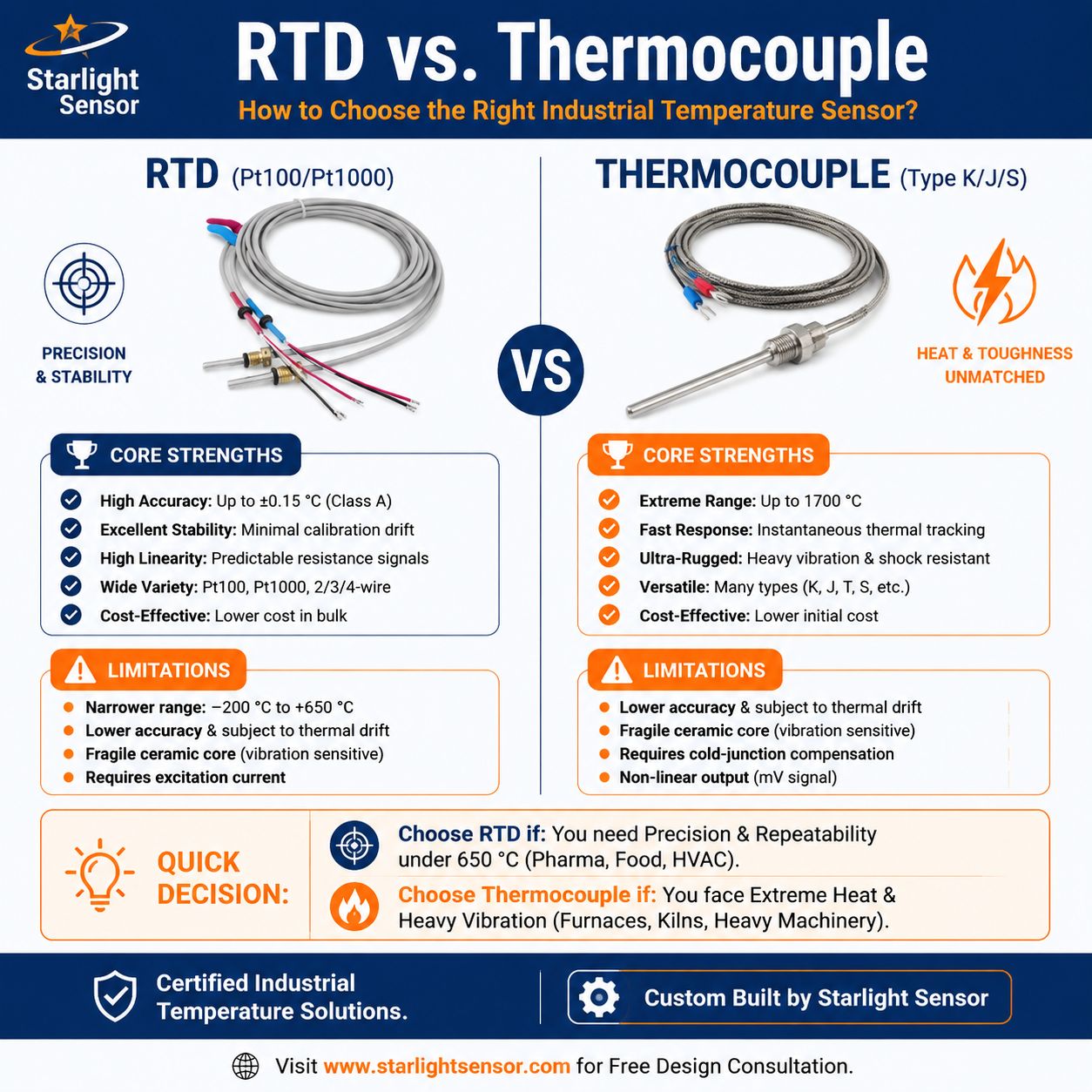
Identify the sensor technology and exact interface required at each point. NTC thermistors need a defined resistance curve and conversion method; RTDs require the specified Pt100/Pt1000 configuration and wiring; thermocouples require a matching input and cold-junction compensation. Confirm channel count, cable length, connector, scan sequence, units, and the controller or logger model.
Specify the probe assembly for storage conditions
Define insertion or suspension method, probe length, cable construction, mechanical support, strain relief, connector, and any protective sheath. Consider abrasion, dust, moisture, condensation, airflow, handling during loading/unloading, and the forces applied to the probe. Confirm materials and installation arrangements for the actual storage site.
Plan data review and maintenance
Set reading intervals, location labels, acceptable range checks, and procedures for missing, stale, or implausible data. Compare sensor readings at commissioning and document inspection, calibration, cleaning, and replacement criteria. A temperature reading is one input to storage management; the overall monitoring and response plan must be established by the grain-storage operator.
Grain temperature probe RFQ checklist
- Storage drawing, grain depth, access, probe locations, point count, and spacing.
- Sensor type/curve, readout or logger model, wiring, cable length, and channel mapping.
- Probe length, suspension/insertion, support, sheath, connector, and strain relief.
- Dust, moisture, condensation, abrasion, handling, and operating conditions.
- Reading interval, calibration, inspection, sample quantity, production volume, and revision.
Request a probe review
Browse the temperature sensor range and include a storage-layout drawing, point plan, and logger input details when you contact Starlight about an OEM probe. Confirm point configuration, materials, and monitoring interface for the specific project.