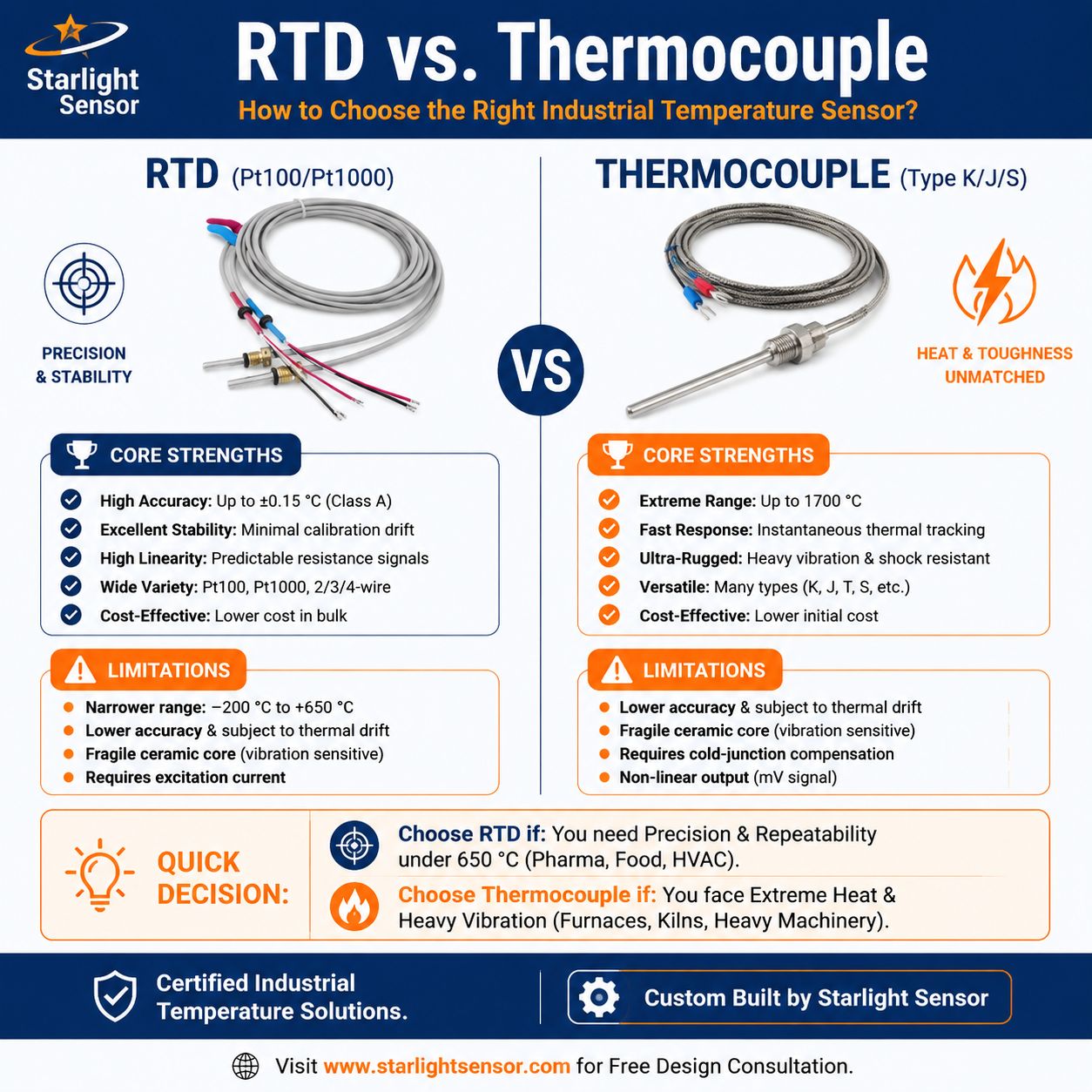
An iron-constantan thermocouple is commonly designated Type J: the positive leg is iron and the negative leg is a copper-nickel alloy commonly called constantan. Confirm the letter type, wire grade, calibration tolerance, and completed probe construction on the project documentation. Similar-looking thermocouple leads or connectors are not automatically interchangeable.
Match the Type J signal to the instrument
Specify a controller or transmitter configured for Type J, including the required temperature range, conversion function, cold-junction compensation, polarity, and extension or compensation wire. Check terminal blocks and connector materials so unintended dissimilar-metal junctions do not compromise the measurement. Define the readout resolution, filtering, and alarm limits for the application.
Review process atmosphere and service conditions
Type J uses an iron positive leg, so exposure to moisture, oxidation, corrosive media, reducing conditions, or temperature cycling should be considered in selecting insulation, sheath, junction, and protection. Do not infer a safe service limit from the thermocouple letter alone; allowable operation depends on the wire, diameter, insulation, sheath, atmosphere, and finished assembly. Confirm these limits for the selected construction.
Specify the probe and installation
Define sensing point, sheath material and dimensions, insertion depth, mounting, junction style, cable length, connector, lead routing, vibration, pressure, and response needs. Ensure probe location and thermal contact represent the intended measurement point. Coordinate process fittings or thermowell dimensions with the installation drawing.
Commission and maintain the measurement
Validate polarity, wiring, Type J instrument configuration, cold-junction compensation, and readings at representative operating points. Establish calibration points and acceptance criteria, then document inspection for lead or sheath damage, moisture ingress, drift, and connector wear according to site conditions.
Type J thermocouple RFQ checklist
- Type J designation, wire grade, tolerance, temperature span, and calibration need.
- Controller/input model, conversion, compensation, polarity, and extension wire.
- Junction, sheath material/dimensions, insertion, mounting, insulation, and cable.
- Atmosphere, moisture, chemicals, vibration, pressure, cycling, and service life.
- Drawing revision, samples, production volume, inspection, and traceability.
Compare thermocouple types
Compare Type J with K, T, E, and N in the thermocouple type guide. For standard type descriptions and reference information, consult NIST’s thermocouple reference. Review the thermocouple sensor range and share your process drawing through the OEM contact page to confirm model-specific availability and construction.