A “Modbus temperature sensor” can refer to a temperature probe connected to a Modbus-enabled transmitter, controller, or gateway. Many sensing elements provide resistance or thermoelectric signals and do not communicate over Modbus on their own. Specify the complete measurement chain and confirm which device converts the sensor signal and exposes the Modbus data.
Define the sensor-to-Modbus architecture
Document the probe, input module or transmitter, network interface, master/client, and supervisory system. Confirm whether the selected equipment uses Modbus RTU or Modbus TCP and check the communication medium, port, addressing, and supported function codes in the device documentation. Do not infer protocol support from the sensor element alone.
Specify the temperature input
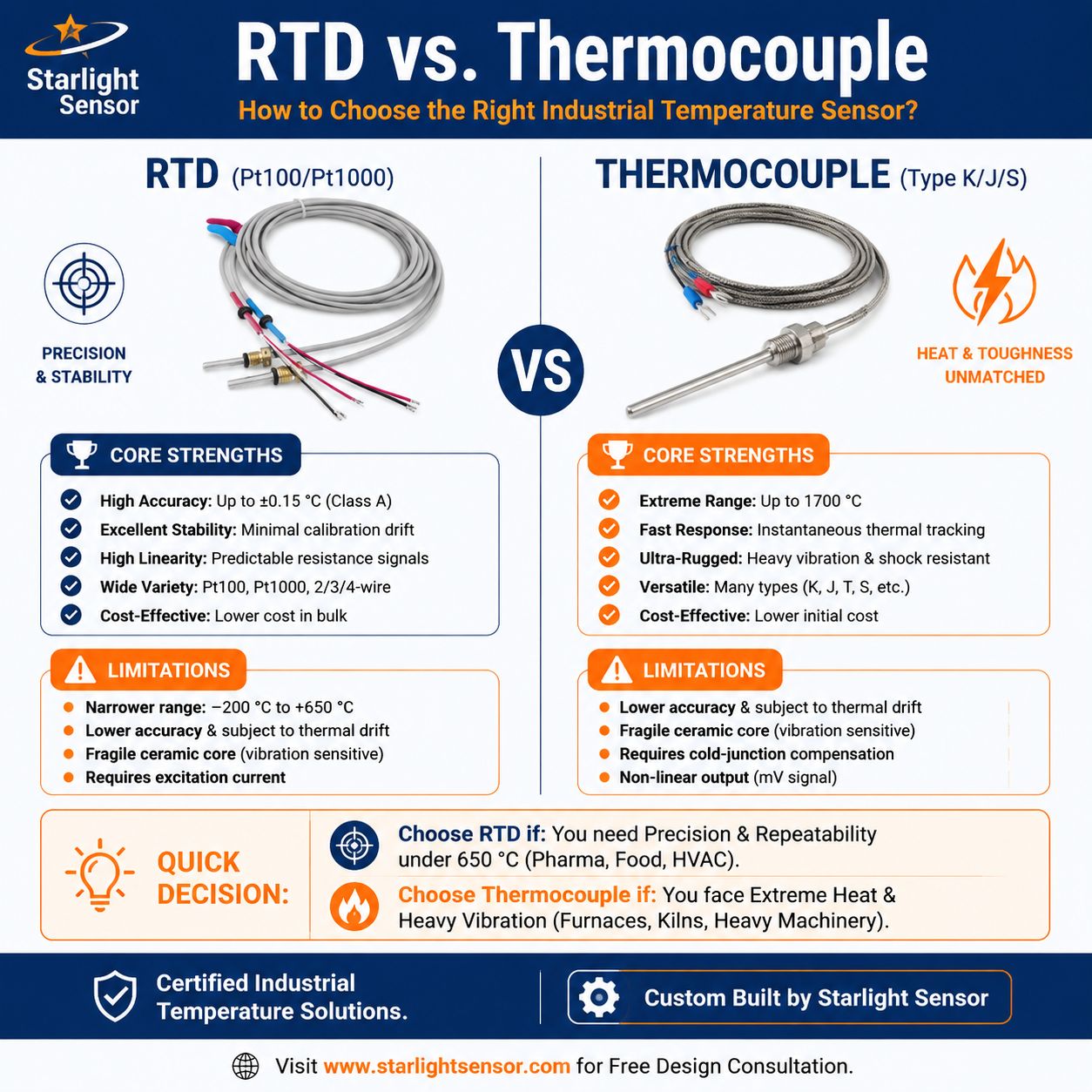
Identify the sensor type and input configuration. For an NTC thermistor, define the resistance curve and conversion method; for an RTD, specify Pt100 or Pt1000 and wiring; for a thermocouple, state the type and cold-junction compensation requirement. Confirm the transmitter accepts that input and its required span, tolerance, and wiring before selecting the probe.
Verify register mapping and data handling
Obtain the device register map and define register address, data type, byte and word order, scaling, units, signedness, update rate, and status or fault fields. Test readings against a known input and check what the master receives during sensor faults, communication timeouts, restarts, and out-of-range conditions. Document polling intervals and stale-data handling for the application.
Match the probe to the installation
Specify probe dimensions, sheath, lead wire, cable length, connector, mounting, response needs, and exposure to moisture, chemicals, vibration, or thermal cycling. Consider cable routing, electrical noise, grounding, and transmitter location. Validate the assembled sensor and Modbus device together at representative measurement points.
Modbus temperature sensor RFQ checklist
- Probe technology, curve/type, temperature range, and tolerance.
- Transmitter/controller model and input configuration.
- Modbus RTU/TCP mode, master details, register map, data format, and polling needs.
- Probe construction, dimensions, mounting, cable, connector, and operating environment.
- Fault/status handling, calibration, drawing revision, sample quantity, and production volume.
Review temperature probe options
Browse the temperature sensor range and include the transmitter model and register documentation when you request an OEM probe review. Confirm the sensor input, communications device, and model-specific performance as a system before design-in.