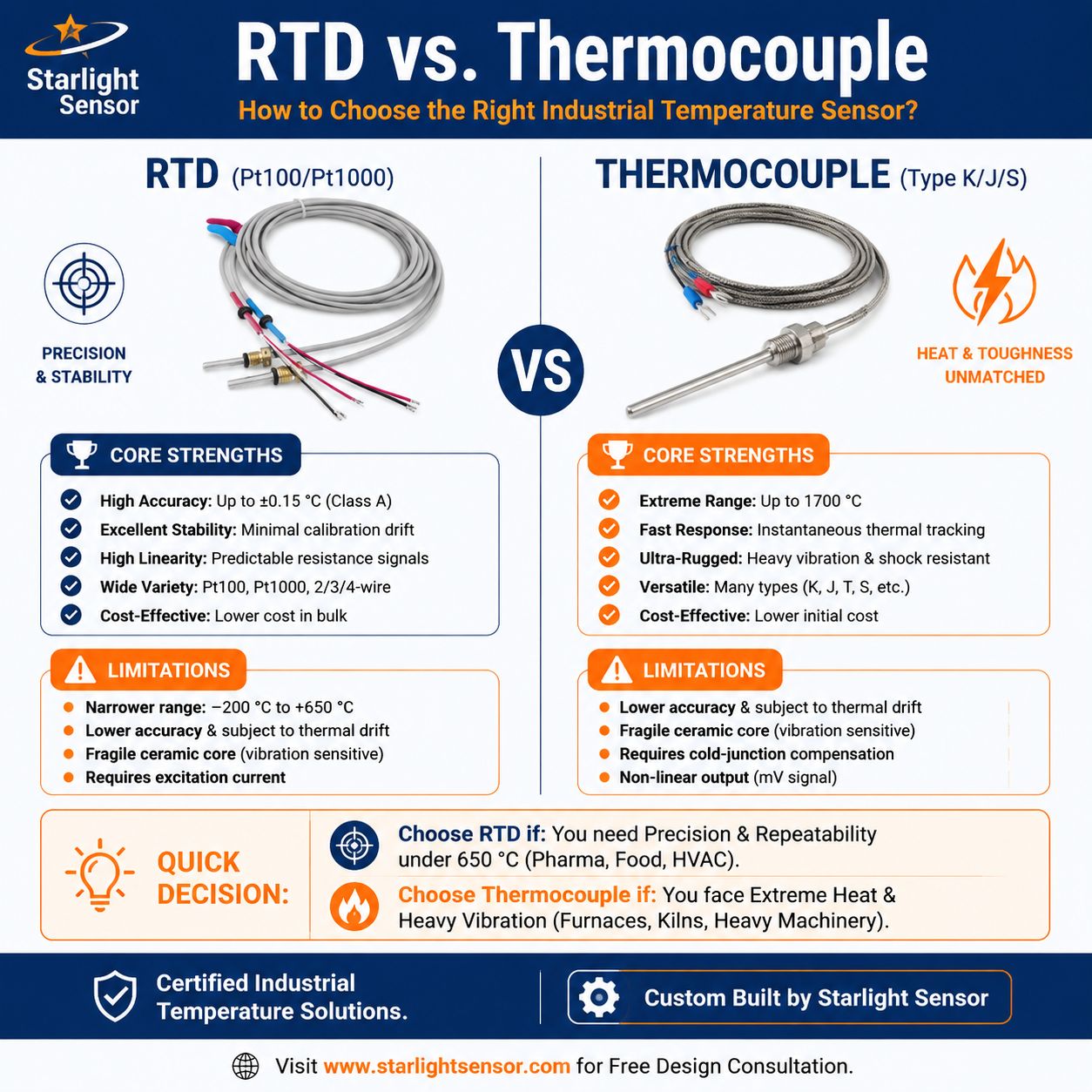
A flange-mounted Pt100 RTD combines a platinum sensing element with a mechanical connection intended to locate the probe at process equipment. “Flange-mounted” does not define one universal flange size, probe depth, pressure rating, or accuracy class. OEMs should specify the mounting interface and the complete measurement assembly for the actual pipe, vessel, or process connection.
A Pt100 has a nominal resistance of 100 Ω at 0 °C under the applicable industrial resistance–temperature relationship. The current IEC 60751:2022 defines requirements and resistance-versus-temperature relationships for industrial platinum resistance thermometers and sensors. Confirm the required tolerance class, element construction, temperature range, and applicable standard with the device or system specification.
Define the flange and process connection
Provide the flange standard or drawing, nominal size, facing, bolt pattern, gasket or seal arrangement, material, and allowable installation orientation. State whether the sensor is installed directly, through a thermowell, or with a separate adapter. These choices affect mechanical fit, sealing, serviceability, heat transfer, and the distance between the RTD element and the process.
Do not infer a pressure or temperature limit from the phrase “flange mounted.” Verify the ratings for the exact flange, seal, probe sheath, welds, and assembled connection. The process designer should assess pressure, flow, vibration, corrosion, and any applicable plant requirements.
Set insertion depth and thermal contact
Specify the probe diameter, insertion length, tip position, and how the sensing element contacts the process or thermowell. A probe that is too short, poorly seated, or thermally isolated can respond to the connection or ambient surroundings rather than the intended process temperature. Required immersion depends on pipe or vessel geometry, flow, fluid properties, thermowell design, and installation location; there is no single insertion ratio that fits every assembly.
For thermowell installations, confirm the bore, insertion length, bottom contact or spring loading, and allowable probe movement against the selected model’s drawing. Follow the manufacturer’s installation instructions and process-safety limits. As one model-specific example, Omega’s RTD installation manual notes that immersion length and process connection installation affect measurement and safe fit; use the exact manual for the device being installed.
Match the RTD wiring to the readout
Choose two-, three-, or four-wire wiring to suit the cable run, controller input, and permitted lead-resistance error. Confirm the element curve and nominal resistance, lead configuration, connector pinout, excitation current, measurement range, and conversion method with the receiving instrument. The resistance element alone does not determine the accuracy of the installed system; wiring, transmitter, controller, mounting, and calibration all contribute.
For a new assembly, compare readings with a suitable reference over the intended operating range in a representative installation. Define stabilization time, test points, acceptance limits, and records with the system owner. Recheck after changes to the flange, thermowell, probe position, cable, or readout.
OEM drawing and inquiry checklist
- Process medium, operating range, pressure, flow and environmental exposure
- Flange standard, dimensions, facing, material, sealing method and drawing
- Probe diameter, insertion length, tip position, sheath and thermowell details
- Pt100 curve/tolerance requirement, wiring, lead length, connector and controller input
- Required testing, documentation, acceptance criteria and expected quantity
Request a model-specific PT100 review
Send the process conditions and mounting drawing through our OEM sensor inquiry form. Browse the PT100/PT1000 RTD range and the paired PT1000 heat-meter sensor for related RTD assembly examples. Confirm the requested flange configuration, exact ratings, and model documentation before selection.