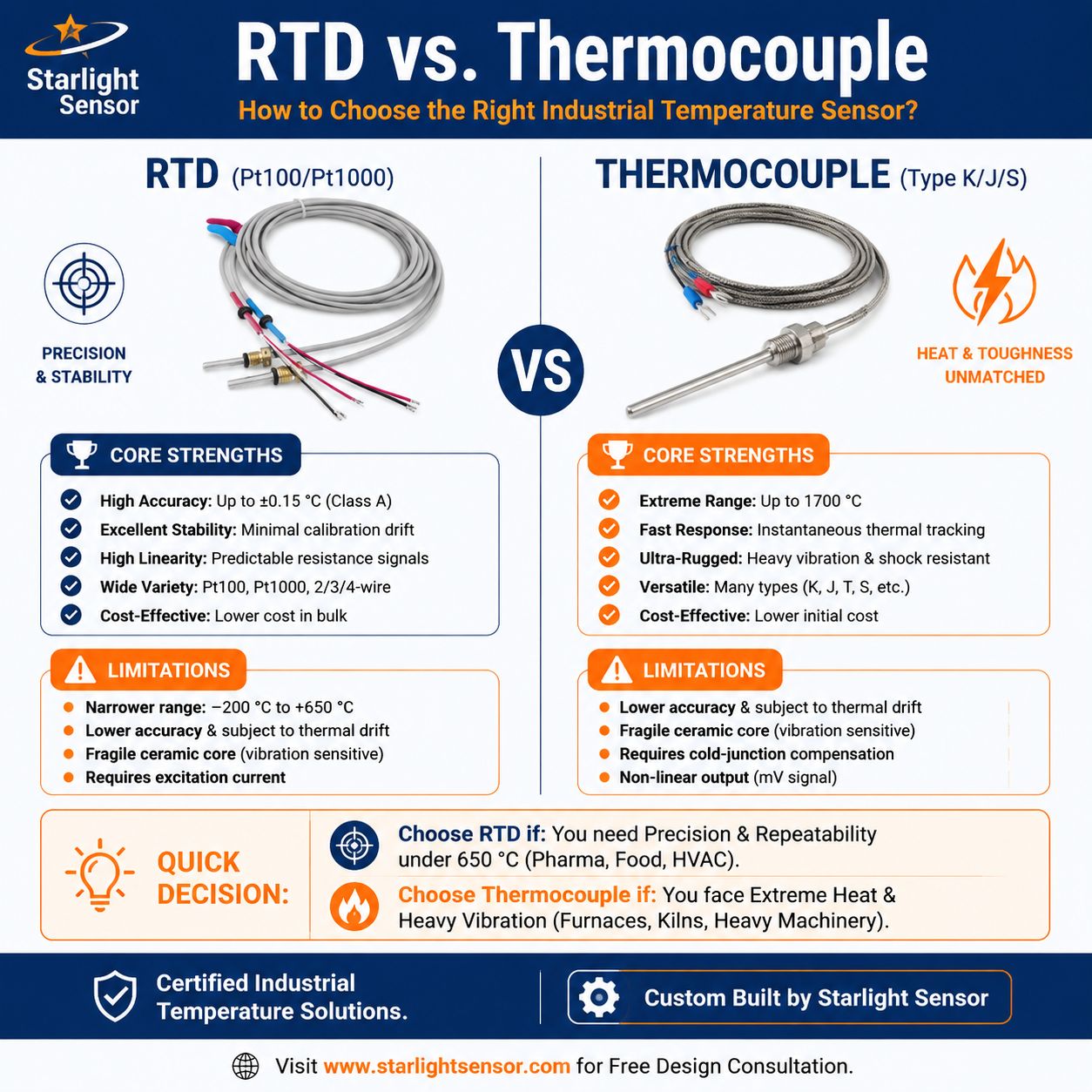
Choosing an industrial temperature sensor starts with the measurement point and operating conditions, then narrows to the sensing technology, probe construction and controller interface. The same process line may need different sensors at the product, pipe wall and ambient locations because heat transfer, pressure, vibration and maintenance access differ.
1. Define the measurement before choosing a sensor
Record the minimum, normal and maximum temperatures at the actual sensing point. Note how quickly temperature changes, whether the process is continuous or cyclic, and whether the probe contacts air, a solid surface or a fluid. Also document pressure, flow, moisture, cleaning chemicals, vibration, electrical noise and available installation space. These conditions determine what the probe assembly must withstand; a sensing element alone does not establish the finished sensor’s limits.
2. Choose a sensing technology that fits the range and system
- NTC thermistors: Resistance decreases as temperature rises, with a nonlinear resistance-temperature relationship. They are often considered for compact equipment and control circuits. Select using the specific R/T curve, reference resistance, tolerance, operating conditions and circuit input.
- RTDs such as Pt100 or Pt1000: Resistance increases with temperature. Check the applicable standard and tolerance class, 2-, 3- or 4-wire connection, lead resistance, excitation current and transmitter/controller input. Verify the exact probe assembly’s temperature and environmental limits.
- Thermocouples: Produce a small voltage related to the temperature difference between the measuring junction and reference junction. Specify the thermocouple type, extension or compensation cable, polarity, cold-junction compensation and instrument compatibility. Probe sheath and junction construction affect installation and service life.
These are technology-level distinctions, not guaranteed accuracy or range values for every product. Compare the candidate’s datasheet and assembly specification against the real application.
3. Match the probe and installation
Specify insertion depth, probe diameter and length, mounting thread or flange, sheath or wetted material, cable length, insulation, connector and strain relief. For fluid measurements, consider flow, pressure, immersion depth and whether a thermowell is required by the process design. For surface measurements, describe contact method, clamping force, insulation and the surface finish. Poor thermal contact or an unsuitable mounting location can make the reading differ from the process temperature.
4. Check the electrical interface
Confirm whether the receiving equipment expects resistance, thermocouple millivolts, a transmitter output or a digital interface. Match wiring type, input range, sensor type configuration, excitation and compensation to the controller or PLC. For long cable runs or electrically noisy environments, review cable routing, shielding, grounding and transmitter placement with the system designer.
5. Validate the complete measurement chain
Before production, test the sensor with its intended cable, connector, mounting arrangement and instrument. Compare readings at application-relevant points with a suitable reference; check repeatability, settling behavior and the effect of installation. Set acceptance limits based on the process requirement, and document calibration or verification methods where required. Do not assume a sensor technology alone guarantees system-level accuracy.
Industrial temperature sensor RFQ checklist
- Measured medium or surface, location, temperature range and cycling profile.
- Required tolerance or system error target and reference/calibration needs.
- Pressure, flow, moisture, chemicals, vibration and cleaning conditions.
- Probe dimensions, insertion depth, mounting, materials and drawing.
- Cable length and construction, connector, wiring and controller input.
- Annual quantity, prototype timing, qualification requirements and documentation.
Explore Starlight Sensors’ temperature sensor products, including NTC thermistors, RTD sensors and thermocouples. For an OEM review, request a quote and share the application conditions, installation drawing and electrical interface. The team can assess the required configuration against the project details.