A miniature temperature sensor probe is selected around the available space, measurement point, response requirement, and readout—not size alone. Before specifying a compact probe, confirm the sensing element, complete assembly dimensions, mounting method, cable exit, and environmental exposure. The required final size and tolerances should be shown on the OEM drawing and reviewed for the application.
Define the installation envelope
Measure the available diameter, length, insertion depth, bend radius, clearance, and mounting area. Identify whether the sensing point contacts a surface, enters a bore, or sits in a fluid or air stream. Include the location of the junction or sensing element, since the overall housing dimensions do not by themselves indicate where the measurement is taken.
Choose the sensing element and interface
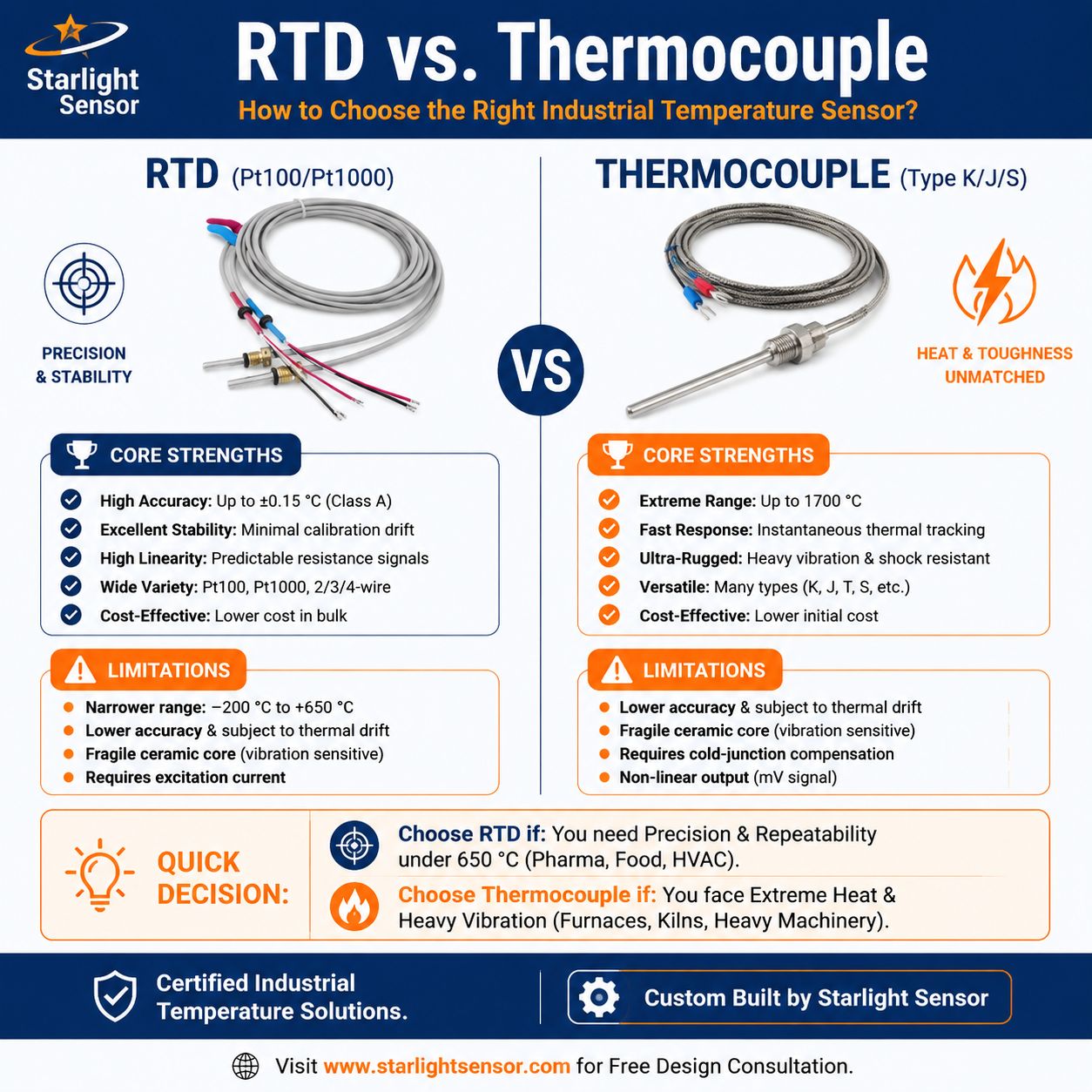
Compact probes may use different sensing technologies, each with specific readout requirements. For an NTC, provide nominal resistance, B-value reference, tolerance, and conversion method. For an RTD, specify Pt100 or Pt1000, wiring, and compatible excitation. For a thermocouple, define the type, polarity, extension wiring, and cold-junction compensation. Confirm that the controller accepts the chosen element and that any required curve or conversion is documented.
Balance response, protection, and durability
Smaller assemblies may respond differently from larger ones, but response also depends on element construction, sheath material, wall thickness, mounting, and heat transfer at the measurement point. Define the required response method and acceptance criteria. Specify moisture, chemical, pressure, vibration, thermal cycling, cable strain relief, and service-life conditions so a compact design is not under-protected.
Validate the assembled miniature probe
Test the probe in its intended mounting with the selected readout. Check fit, repeatability, response, electrical stability, and readings across representative operating points. Include assembly tolerances and cable/connector clearance in the validation rather than testing the sensing element by itself.
Mini temperature probe RFQ checklist
- Maximum envelope, sensing point, insertion/contact method, mounting, and drawing tolerances.
- Sensor type, resistance curve or thermocouple type, tolerance, range, and readout.
- Sheath, insulation, cable, connector, bend/strain relief, and cable exit direction.
- Response requirement, process exposure, vibration, moisture, and chemical conditions.
- Samples, production volume, inspection criteria, calibration, and drawing revision.
Review compact probe options
Browse the temperature sensor range and NTC sensor options. Share the available dimensions, mounting drawing, controller input, and operating conditions through the OEM contact page for a model-specific review.