NTC thermistors are used in many electronic assemblies to sense temperature, but an NTC element alone does not establish that a component is suitable for a medical device or a patient-contact application. OEM teams should evaluate the complete sensor assembly, measurement circuit, intended use, and verification plan against their own product requirements. This guide outlines the information to define before requesting a thermistor or probe review.
For general component context, see the NTC sensor range. Product suitability, ratings, and documentation must be confirmed for the exact model and assembly under review.
Table of contents
- Define the measurement point and conditions
- Match the NTC curve to the circuit
- Evaluate the finished probe assembly
- Plan verification and documentation
Define the measurement point and conditions
Start with what the device needs to measure and where the sensing element will sit. Record the expected temperature range, ambient conditions, thermal contact, response-time target, and whether the sensor is exposed to airflow, liquid, cleaning agents, or repeated handling. The temperature at the thermistor can differ from the temperature of the target because of mounting, enclosure, thermal path, and surrounding materials; evaluate the installed configuration rather than relying only on a loose-element specification.
Also identify whether the sensor is internal to equipment, attached to a surface, or intended to contact a person or sample. The device manufacturer must determine the intended-use requirements and any applicable safety, regulatory, or quality controls. Do not infer medical-device approval, patient-contact suitability, or clinical performance from an NTC material or a generic product description.
Match the NTC curve to the circuit
For an NTC, resistance decreases as temperature rises. Selection should use the exact model’s resistance–temperature data across the required range, not only a nominal resistance at 25 °C or a single Beta value. Confirm R25, the stated Beta interval or full R/T table, tolerance, operating range, and any interchangeability requirements against the device’s measurement algorithm. TDK’s NTC technical overview describes the R/T relationship and explains that measurement current can cause self-heating.
Review the complete signal path: divider or excitation current, ADC input range and resolution, reference stability, wiring resistance, filtering, sampling interval, and conversion method. Measurement current should be low enough to keep self-heating within the system’s error budget under the actual mounting and thermal conditions. For design background, see our NTC thermistor circuit guide and NTC R/T calculation guide.
Evaluate the finished probe assembly
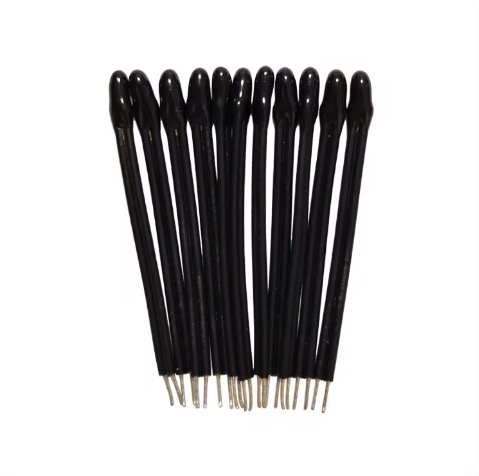
The sensing element is only one part of the measurement chain. Specify the bead or chip package, probe sheath or housing, dimensions, cable length and insulation, connector or termination, strain relief, sealing needs, and mounting method. If cleaning or disinfection is relevant, provide the actual agents, concentration, temperature, contact time, and number of cycles so the assembly can be assessed. Sterilization exposure should be evaluated only when it is part of the defined use conditions and supported by model-specific evidence.
Thermal response and measurement error depend on the assembled probe and its environment. Request drawings and model-specific data for the proposed configuration, then evaluate it in a representative fixture. The custom NTC probe assembly guide describes the information OEM teams can provide when specifying a probe.
Plan verification and documentation
Before design freeze, compare the sensor assembly with a traceable reference over the intended operating range and in the installed configuration. Define the test setup, stabilization time, repeatability checks, acceptance limits, and records with the device engineering and quality teams. Recheck after relevant environmental or cleaning exposures if those are part of the use conditions. Acceptance criteria belong to the device manufacturer’s requirements and validation process.
When requesting an OEM review, include:
- Intended measurement point and operating temperature range
- Target R25, required R/T data or Beta interval, tolerance, and conversion method
- Probe dimensions, mounting, housing material, cable, connector, and drawing
- Environmental, cleaning, or sterilization conditions, when applicable
- Electrical interface, verification plan, documentation needs, and expected quantity
Request a model-specific NTC review
Send the requirements and a drawing or sample reference through our OEM sensor inquiry form. You can also review the MF52D NTC thermistor listing as a component reference; confirm its model-specific specifications and intended-use suitability with your engineering team before selection. If the equipment design specifies a platinum RTD instead, see our RTD sensor integration guide for medical equipment.