Look beyond the sensor purchase price
For an industrial measurement point, the sensor’s purchase price is only one part of the cost over the equipment’s service life. A useful evaluation considers the specified probe, its integration into the equipment, verification and ongoing maintenance. Compare alternatives against the same measurement task and service conditions; do not assume a sensor technology is always cheaper or more accurate than another.
Build a lifecycle cost checklist
- Sensor and assembly: consider the sensing element, probe materials and dimensions, fitting, cable, connector and required custom construction. Compare complete assemblies with the same drawing and scope.
- Integration: account for the mechanical fit, installation access, wiring, controller input, signal conditioning and any engineering needed to qualify the sensor in the equipment.
- Verification: define inspection, incoming checks, calibration evidence or sample approval required by the project. State the acceptance criteria and confirm which records are included.
- Service and replacement: review accessibility, connector or lead replacement, maintenance procedures and spare-part requirements for the actual installation. Avoid assuming a service interval without application data.
- Risk of mismatch: evaluate how an incorrect curve, tolerance, probe fit or environmental construction could affect commissioning and measurement performance. Validate the selected assembly under representative conditions.
Compare options against one measurement requirement
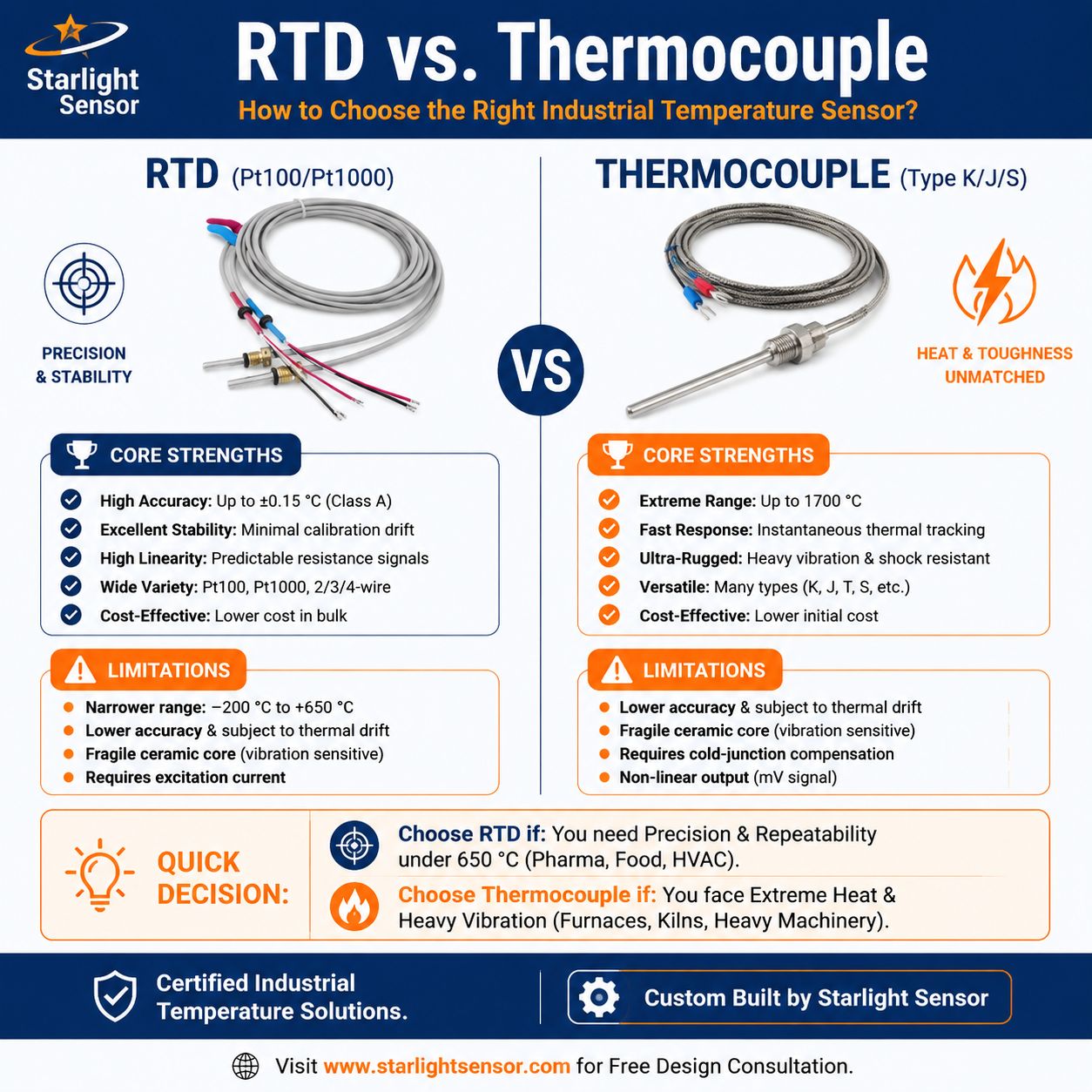
First document the measurement point, operating and excursion conditions, target system performance, process medium, mounting and controller input. Then compare RTD, thermocouple or NTC options using the same finished assembly scope, installation assumptions and verification plan. Separate one-time development or tooling effort from recurring component cost when suppliers provide those figures. Keep any project-specific commercial assumptions visible; there is no universal price or cost-saving amount that applies to every design.
Questions for an OEM sensor review
- What complete sensor assembly and interface does the application require?
- Which system-level performance criteria and controller input must be met?
- What verification evidence and sample approval are required before production?
- How will the installed sensor be accessed, inspected and replaced if needed?
- Which quantities, development steps, documentation and supply terms are included in the comparison?
Review the RTD, thermocouple and NTC ranges to identify possible measurement approaches. For a supplier quotation, provide the drawing, application conditions and verification requirements through our OEM inquiry page. Final lifecycle cost depends on the actual equipment, validated assembly and service plan.