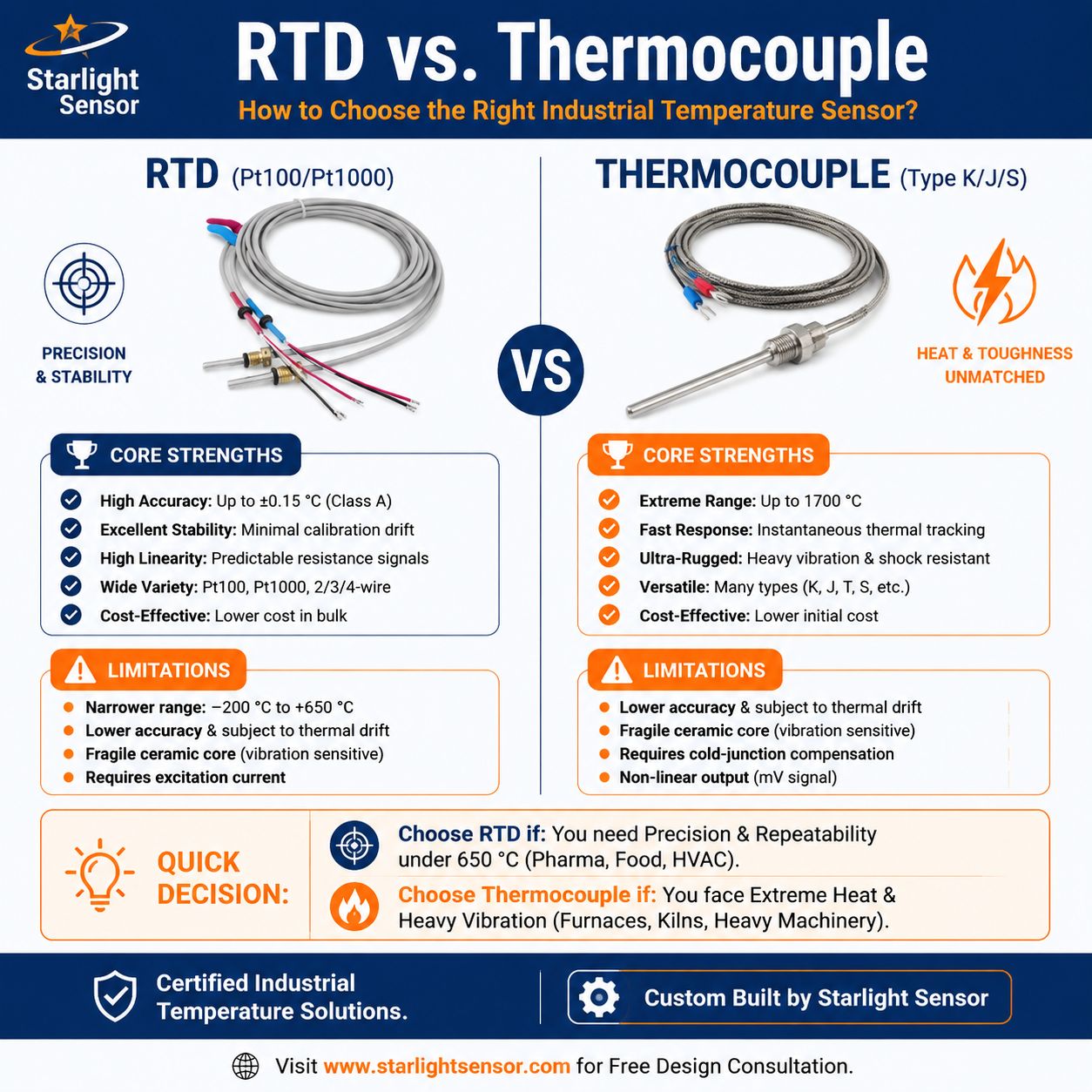
Pt100 describes a platinum resistance temperature detector (RTD) with a nominal resistance of 100 Ω at 0 °C under the applicable RTD convention. A Pt100 is the sensing element; a temperature transmitter is separate electronics that measures the RTD and converts its signal for a controller or monitoring system. Some products combine a probe and transmitter in one assembly, so confirm the actual scope of supply.
How a Pt100 sensor works with a transmitter
The measuring instrument supplies or controls the RTD measurement circuit, reads the element resistance, and applies the configured resistance-temperature relationship. A transmitter then conditions and maps that measurement to its configured output, such as a current loop or another model-specific interface. The output range, sensor input, wiring, and configuration must all match the receiving system.
Pt100 elements are available in different constructions, tolerances, probe geometries, lead configurations, and connection styles. Do not assume every Pt100 probe has the same response, temperature capability, sheath, or accuracy. Confirm the element class and applicable standard, temperature range, construction, immersion or mounting conditions, and documentation for the exact assembly.
Choose the RTD lead configuration
Lead resistance can affect an RTD measurement. Two-wire connections are simple but include lead resistance in the measured circuit; three-wire arrangements are commonly used to compensate for lead effects when supported and correctly connected; four-wire measurement can separate sense and current leads in compatible instruments. The achievable measurement performance depends on the complete sensor, cable, transmitter, installation, and receiving electronics—not just the Pt100 element.
Before ordering, confirm whether the transmitter accepts Pt100, the required wire configuration, the applicable curve/standard, input range, excitation and fault behavior, isolation, supply, and output scaling. The Analog Devices guide to RTD system design discusses system-level design considerations; transmitter requirements remain model-specific.
Pt100 versus Pt1000
Pt100 and Pt1000 identify different nominal resistance values at 0 °C. They are not interchangeable at the transmitter input unless the instrument is configured for the selected element. Check the sensor type, wiring, input range, linearization, and the controller or transmitter configuration before substitution. A Pt1000 does not automatically produce a more accurate finished measurement; the full signal chain and application determine the result.
OEM selection checklist
- Pt100 element class/standard, curve, temperature range, and required test documentation.
- Probe diameter and length, sheath/material, process connection, immersion, and mounting constraints.
- Two-, three-, or four-wire cable, lead length, connector, routing, and environmental protection.
- Separate or integrated transmitter; accepted RTD input, supply, mounting, output, scaling, and receiving instrument.
- Operating quantity, drawing revision, sample approval, inspection needs, and delivery requirements.
Specify a compatible sensor assembly
Explore our RTD temperature sensor range and share your drawing or sample, Pt100 configuration, mechanical fit, operating conditions, cable/connector, and transmitter or controller model through our OEM inquiry page. The interface and offered assembly should be confirmed against your requirements before production.