“Waterproof” is not a complete sensor specification. For an OEM temperature probe, suitability depends on the assembled sensing element, sheath or housing, cable entry, connector, seals, mounting and the actual exposure conditions. A rating or material choice must be confirmed for the specific assembly and use case.
Define the water exposure before choosing a probe
Describe whether the probe will encounter splashes, washdown, condensation, temporary immersion, continuous immersion or a pressurized stream. State the medium, temperature, depth or pressure, exposure duration, cleaning method and expected service life. These conditions are not interchangeable, and a general “waterproof” label does not establish suitability for every environment.
Specify what an ingress-protection rating covers
IEC 60529 defines an IP Code for degrees of protection provided by enclosures. When a project requires an IP rating, identify the exact rating and test basis required by the end product, then confirm that evidence applies to the complete delivered assembly—including the cable entry, connector, mating parts and installation arrangement as relevant. A rating for a housing or test sample should not automatically be attributed to a different probe configuration. See the IEC 60529 standard listing and verify the applicable edition and requirements with your compliance team.
Review wetted materials, seals and cable routing
List the fluid or cleaning agents and their concentration, temperature and contact time. Ask the supplier to confirm the wetted sheath, seal and connector materials against those conditions. Check cable-jacket compatibility, bend radius, strain relief, connector exposure and how the probe is mounted. For a submerged probe, the sensor body alone is not the full boundary: water can enter through joints, cable transitions or a connector that is not sealed in the installed configuration.
Match the sensing element and mechanical design
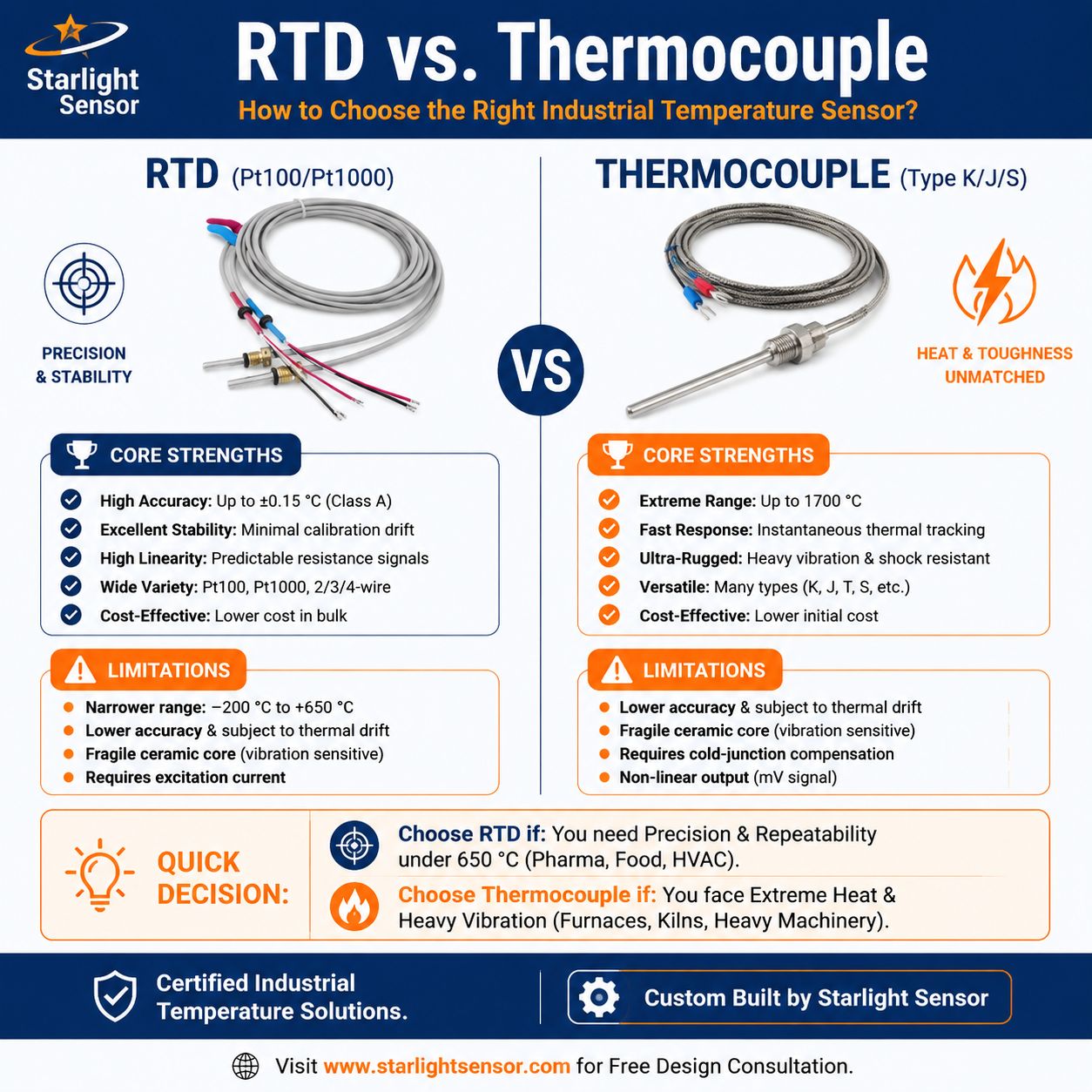
Select NTC, RTD or thermocouple technology to match the required temperature range, controller input and measurement requirements; verify every limit on the chosen model’s datasheet. Then specify probe diameter, insertion length, sheath, lead or cable, connector, mounting thread or bracket and installation orientation. Heat conducted along the sheath, placement, flow and contact with the measured medium can affect the reading, so validate the assembled probe in the real installation rather than assuming a general response or accuracy claim.
Validate the complete assembly
Agree on acceptance criteria before production. Depending on the application, validation may include visual inspection, electrical checks, temperature comparison, immersion or washdown testing, cable flexing and post-exposure checks. The method, sample size, test conditions and pass/fail limits should reflect the actual product specification; do not assume a test or certification has been performed unless the supplier provides supporting records for the configuration being purchased.
OEM inquiry checklist
- Temperature range, required sensor technology and controller input.
- Exposure type, medium, temperature, immersion depth/pressure and duration.
- Required IP code or other end-product acceptance criteria.
- Wetted materials, cleaning agents, sheath, seal and connector arrangement.
- Probe dimensions, mounting, cable length/jacket and routing constraints.
- Drawing or sample, annual quantity estimate and validation evidence required.
Send the application conditions and probe drawing for an OEM review. Browse temperature sensor options, RTD sensors and NTC thermistors, or request a quote.