MQTT can carry temperature readings from a sensor interface, controller, or gateway to a broker and downstream application. A probe is not automatically an MQTT device: confirm where measurement conversion occurs, which device publishes the message, and whether the communication path meets the project’s security and reliability requirements.
Define the measurement and publishing architecture
Document the sensing element, acquisition hardware, network path, MQTT broker, and consuming application. Identify the point at which raw resistance or thermocouple voltage becomes a temperature value. Confirm the controller or gateway supports the required sensor input and can publish data in the agreed format and interval.
Specify a stable MQTT message
Agree on topic names, payload structure, units, timestamps, device or channel identifiers, and quality/status fields. Define how retained messages, QoS, reconnect behavior, duplicate delivery, and stale readings are handled for the chosen client and broker. Consumers should validate payloads and timestamps instead of treating every received message as a current, valid measurement.
Match the temperature probe to its input
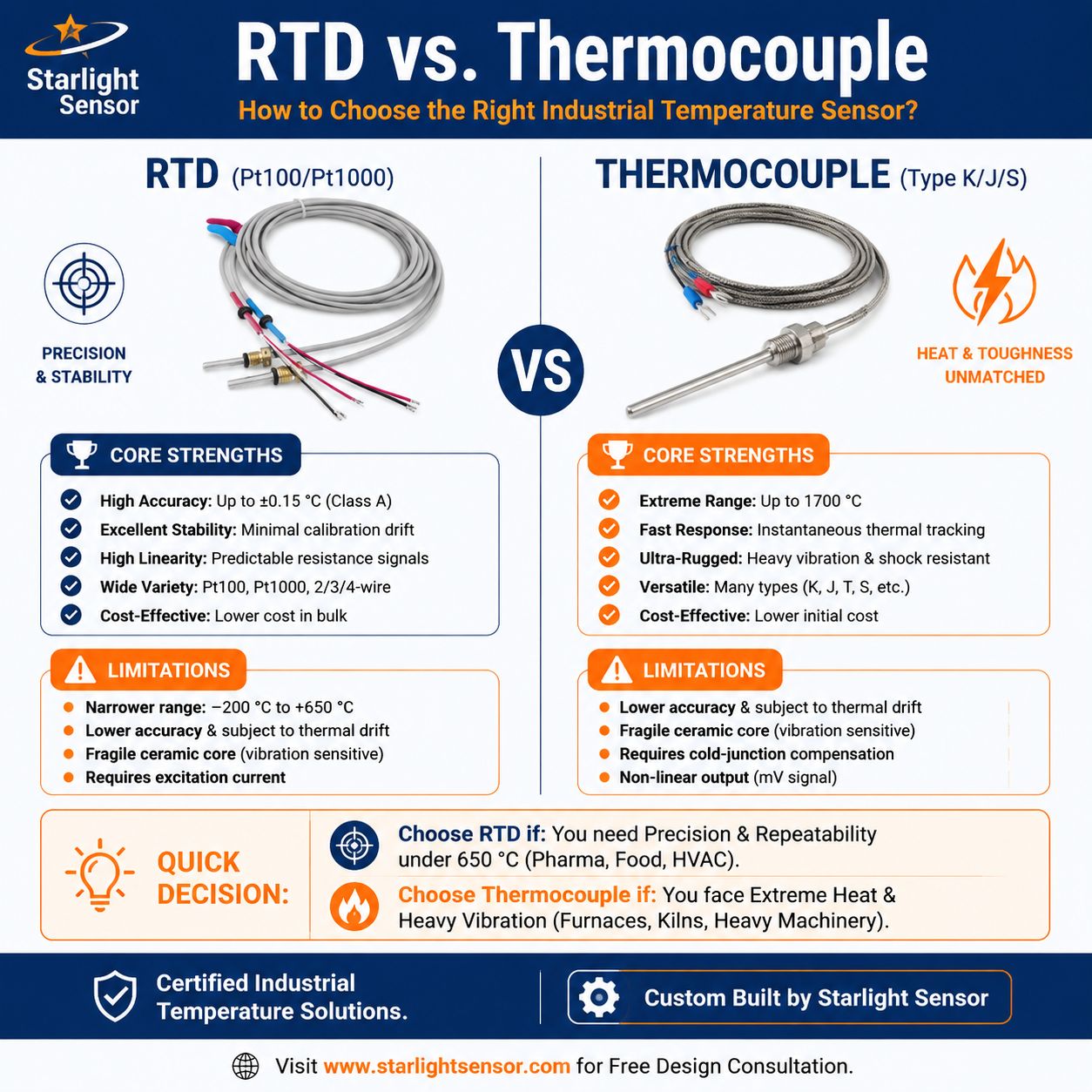
For an NTC thermistor, specify nominal resistance, B-value reference, tolerance, and the controller’s conversion method. For an RTD, define Pt100 or Pt1000, wiring, excitation, and input module. For a thermocouple, identify the type, extension wiring, and cold-junction compensation capability. Specify probe dimensions, sheath, cable, connector, mounting, response, and environmental exposure. Verify the assembled probe with the selected controller before commissioning.
Protect and validate the data path
Use the project’s approved authentication, access controls, and transport protections for broker connections. Separate device permissions according to the deployment design and avoid exposing credentials in topic payloads or flow exports. Test startup, loss of network, broker restart, sensor fault, delayed data, and recovery. Record sample rate, alarm thresholds, and expected safe behavior for stale or invalid readings.
MQTT temperature sensor RFQ checklist
- Sensor type, temperature span, accuracy need, and calibration points.
- Controller/gateway model, input type, firmware, and supported MQTT client behavior.
- Topic, payload fields, units, timestamp format, publishing interval, and status handling.
- Probe construction, dimensions, cable, connector, mounting, and process environment.
- Network/security requirements, fault cases, drawing revision, quantity, and inspection records.
Continue integration planning
For a flow-based implementation, review the Node-RED temperature sensor integration guide. Browse the temperature sensor range and include the controller or gateway model when you contact Starlight for an OEM review. Compatibility and sensor construction should be confirmed for the selected model before design-in.