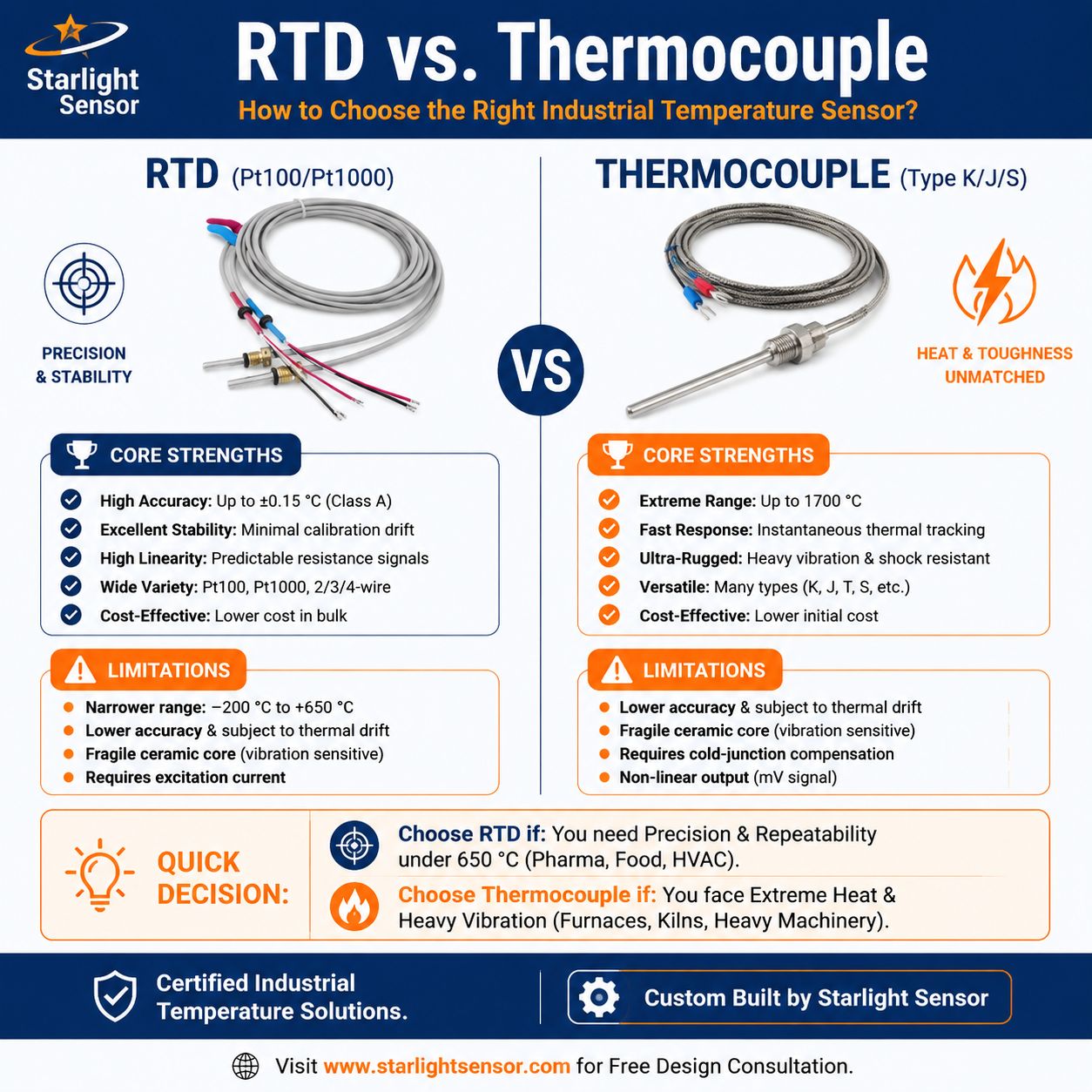
“RTD thermistor” is often used as a catch-all search phrase, but an RTD and a thermistor are different temperature-sensing elements. An RTD derives temperature from a predictable resistance change, commonly using platinum; an NTC or PTC thermistor uses a semiconductor material with its own resistance-temperature curve. Choose the sensing element from the application and controller requirements, then specify the finished probe separately.
RTD vs thermistor: the basic difference
An RTD is typically selected when its resistance behavior, repeatability, and system accuracy requirements suit the application. A thermistor can offer a useful resistance response over its intended range, but its curve, tolerance, excitation, and self-heating must be considered in the measurement circuit. These are broad design characteristics, not guarantees for every model or finished assembly. Texas Instruments provides a comparison of RTDs, thermistors, thermocouples, and IC temperature sensors for system-level selection.
Select by range, circuit, and installation
Start with the required operating span, accuracy budget, response, stability, sensor-to-controller distance, and available input circuit. For an RTD, confirm nominal resistance, tolerance class, lead arrangement, and compatible excitation/readout. For a thermistor, define the resistance at its reference point, full curve or B-value reference points, curve tolerance, and conversion method. Validate the chosen sensor with the actual electronics and mounting because wiring, self-heating, thermal contact, and calibration affect system results.
Specify the finished probe assembly
The sensing element does not define the complete probe. State the sheath or encapsulation, dimensions, cable and connector, mounting, immersion or surface contact, strain relief, and exposure to moisture, chemicals, vibration, and cleaning. A custom assembly should be reviewed as a complete thermal and mechanical system.
Temperature sensor RFQ checklist
- Measurement point, medium, operating range, and required system accuracy.
- RTD type and tolerance, or thermistor reference resistance/curve and tolerance.
- Controller input, excitation, wiring distance, connector, and calibration method.
- Probe dimensions, materials, mounting, cable, and environmental conditions.
- Sample plan, drawing revision, production quantity, and inspection criteria.
Review RTD and thermistor options
Explore Starlight’s RTD temperature sensors and NTC thermistors and probes. Confirm the exact curve, tolerance, operating limits, construction, and performance on the chosen model’s current documents. For OEM sourcing, send the controller input and mechanical requirements for a configuration review.